



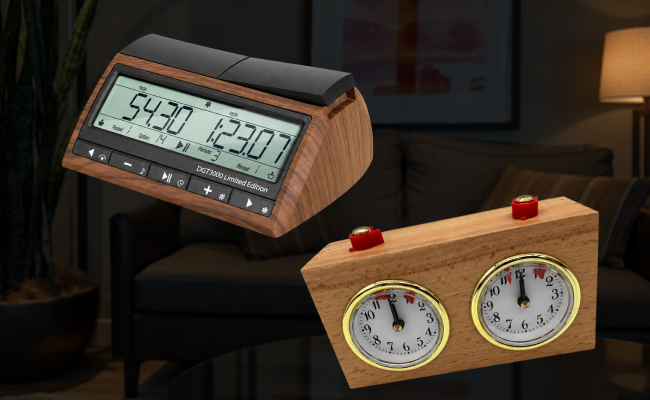
What Is a Chess Clock and Why Does Chess Need One?
A chess clock is two timers in one housing. Only one of them ever runs.
Monopoly doesn't need a clock. Neither does Uno, or snakes and ladders. So why does chess?
Every official chess game played anywhere in the world is timed, and has been for well over a century. The clock isn't an accessory for serious players. It's part of how competitive chess works, and it changes an ordinary game at home more than any other piece of equipment you can buy.
The reason is that almost every other board game runs itself down to an ending. The dice decide things for you, the cards run out, somebody lands on the last square. Chess has none of that. No luck, nothing hidden, nothing running out, and always one more idea worth checking.
Nothing in chess ever tells you to hurry up. So somebody had to build something that does!
In this article, you'll learn:
- What a chess clock is, and why it has two timers rather than one
- What happens when your time runs out, and why players think losing that way is fair
- Why chess spent four hundred years trying to solve slow play politely, and failed
- What increment and delay do, and why they made chess better
- The difference between classical, rapid, blitz and bullet
- Three ways to use a clock at home, including the handicap game that turns a mismatch into a real contest
- What to look for in your first clock
What a Chess Clock Is
Two countdown timers in a single housing, with a button on top of each side. One is yours, one is your opponent's, and only one countdown ever runs at a time.
While you're thinking, your timer counts down. You make your move, then press the button on your side. That press stops your timer and starts your opponent's. Their time drains while yours sits frozen. They think, they move, they press, and it comes back to you.
One thing confuses nearly everybody: the clock has no idea what's happening on the board. It can't see the pieces and doesn't know the rules. It's two stopwatches wired so that starting one stops the other, run entirely by hand.
Chess isn't the only game that uses one, either. The same clocks keep time in serious games of Go and backgammon.

Your press stops your clock and starts theirs. The two totals drift apart as the game goes on.
Why Two Timers Instead of One
One shared timer would tell you when the game has to finish, but not who's responsible for getting there. Two separate timers do: your slow thinking comes out of your budget and nobody else's. Want ten minutes on one move? You're welcome to, it'll cost you later, and that's your business.
Which is where that line from the introduction needs correcting. A chess clock isn't really there to hurry you up. It's there to make sure that when you take your time, you're the one paying for it.
Why Pressing the Button Stops Your Clock
Thinking time belongs to whoever's deciding. While you're working out what to play, you're holding up the game, so it comes out of your allowance. The moment your move is on the board, the decision belongs to your opponent, and the cost becomes theirs. The button is the handover, the same logic as a relay baton: the second you let go, it isn't your leg of the race any more.
Which leads to the rule every beginner learns the hard way. Pressing is part of your move, not something you do afterwards. Forget, and your own timer keeps quietly eating away while your opponent sits there perfectly content to let it.
Almost everybody does this once.
Almost nobody does it twice.
What Happens When Your Time Runs Out
If your timer reaches zero, you lose. It doesn't matter how well you were playing or what's on the board.
There's one sensible exception. Your opponent has to be able to checkmate you by some series of legal moves from the position in front of them. If they're down to a lone king, no such series exists, so the game is a draw rather than a win for them.
Running out of time is called flagging, after the mechanical clocks that came first. Those had a small red flag above the twelve, lifted by the minute hand as it came round, and when the hand passed the hour the flag dropped. Nothing beeped, nothing flashed. A small piece of metal fell over, and that was the game, provided somebody noticed.

On an analogue clock, the red flag above the 12 rises as the minute hand approaches, then falls. That drop is where "flagging" comes from.
Why Losing on Time Is Fair
To somebody new this sounds brutal. You were winning, you got the position right, and you lost to a gadget.
Players don't see it that way. Solving the position is only half of what chess tests. The other half is producing a good enough answer inside the time you've got, and a player who finds a brilliant move after forty minutes hasn't outplayed a player who found a very good move in two. They've found the same thing more slowly, and slowness isn't a skill.
Turn it round and it's clearer. Without a time limit, the stronger player is whoever's prepared to sit there longest. With one, the stronger player is whoever's better at chess.
That's also the answer to the honest objection, which is that a countdown surely turns a deep game frantic. A time limit doesn't ask you to think less. It asks you to work out when more thinking stops being worth it, which is a real skill in itself.
Why Chess Couldn't Just Ask Players to Hurry Up
Players could simply agree to be reasonable. Chess tried that for about four hundred years.
It didn't work.
Slow play usually isn't rudeness, it's pressure. When a position's complicated and the result matters, a perfectly considerate person keeps looking for one more idea, and half an hour disappears without anyone deciding it should.
By the mid-1800s it was a serious problem. The Staunton v Saint-Amant match games of 1843 averaged nine hours each, and at the London tournament of 1851 one player spent two hours and twenty minutes over a single move. Howard Staunton accused a fellow competitor, Elijah Williams, of averaging two and a half hours per move in some matches, and credited Williams' slowness with pushing chess to adopt a twenty-minute-per-move limit the following year. Staunton blamed rather a lot of his losses on slow opponents, so historians treat his version with caution.
Worse than the boredom, slow play broke the incentives. A player who was losing had a real reason to crawl, hoping the other side would tire or take a draw just to end it. Chess had accidentally made stamina a winning strategy.
It broke the schedule too, and that is what finally forced a fix. Players sailed in from across Europe and had to book their passage home, so a tournament had to promise a finish date - and no tournament can do that while a single game is free to run all day.
The first attempt came in 1861: a sandglass each, tipped back and forth as the turn changed. Clumsy, but better than nothing.
The real solution arrived in 1883, when Thomas Bright Wilson of the Manchester Chess Club linked two pendulum clocks in one case, so tilting the unit stopped one and started the other. Players used it in competition at the London 1883 tournament.
Nobody has replaced that idea since. They've only refined it.
The Digital Clock, and the Problem It Solved
Bruce Cheney, an electrical engineering student at Cornell University, built the first digital chess clock in 1973 as an undergraduate course project.
Digital clocks were easier to read, but the real change was that a digital clock can do arithmetic. On a mechanical clock your time only ever goes down, so in the last thirty seconds of a close game a player who is completely winning can still lose, not because they misjudged anything but because they couldn't move the pieces and hit the button fast enough.
Two hours of excellent chess, undone by hand speed. So chess players came up with two fixes.
Increment adds a small amount of time every time you press. Three minutes each plus two seconds per move is a common setting. Press, gain two seconds. The clock tops your allowance up instead of only draining it, so the game never comes down to pure panic.
Delay gets there differently. Instead of adding time, the clock waits before it starts counting. With a three-second delay your timer pauses for three seconds after your turn begins, then starts to drain. Move inside those three seconds and you lose nothing.
Increment is the more common of the two today. A plain countdown running straight down to zero is what players call a guillotine finish, and both fixes exist to soften it, so that chess decides a chess game rather than the last-second scramble.
Bobby Fischer usually takes the credit for increment: he filed a US patent for a digital chess clock on 5 August 1988, granted as US Patent 4,884,255 on 28 November 1989. Delay takes its name from Grandmaster David Bronstein. And if Fischer's name rings a bell, he's the same player at the centre of the chess match that stopped the world.

A digital clock can add time as well as subtract it. That one capability is what makes increment and delay possible.
How Long Do You Want the Game to Last?
That's what a time control settles: how much time each player starts with, and how much they gain per move. You'll usually see it written as two numbers - 5+0 is five minutes each with nothing added, 3+2 is three minutes each plus two seconds a move.
Changing the thinking time changes what the game tests. Give someone an hour and chess becomes a calculating game, won by whoever works things out most accurately. Give them three minutes and it becomes a recognising game, played on instinct and nerve.
Same rules, same pieces, genuinely different sports.
A couple of minutes of commentated play, so you can see the rhythm of it. Watch how pressing the button becomes part of the move.
Classical, 60 minutes or more each. Enough time to calculate properly and produce a game you're pleased with afterwards. World championships use this one.
Rapid, roughly 10 to 60 minutes each. The practical setting for most people, and easily the best place to start. Fifteen minutes each plus a ten-second increment makes a very satisfying evening.
Blitz, 3 to 5 minutes each. Too fast to calculate deeply, so it runs on pattern and nerve. Mistakes happen constantly and nobody minds, because the next game starts in thirty seconds. Anyone who thinks chess sounds sedate should be sat down for a few rounds of it.
Bullet, 1 minute each. The clock becomes as much an opponent as the person opposite you. More a test of speed than of chess, enormous fun to watch, and not a format to learn on.
Blitz at the very top of the game. Watch Magnus Carlsen's hand rather than the board.
Three Ways to Use a Clock at Home
In competition both players get identical time, for the same reason both get sixteen pieces: a contest starts level. At home, equal time is often exactly the wrong choice. Each of these needs a board, a clock, and nothing else.
1. Blitz night
Setup: five minutes each, no increment, best of seven.
Casual chess drags for one specific reason: the long silence while somebody stares at the board. Five minutes each caps a game at ten minutes, so losing costs almost nothing and you start again straight away. Seven games with a running scoreline feels completely different to one slow game that quietly loses both players halfway through.
If five minutes feels frantic, try ten minutes each with a five-second increment.
2. The handicap game
Setup: the stronger player gets less time. Ten minutes for the weaker player against three for the stronger one is a reasonable opening offer. Adjust until you're both winning about half.
This solves the single biggest obstacle to chess at home. When a parent plays a child, or an experienced player plays a beginner, everybody knows the result before the first move. The stronger player has to choose between winning joylessly and losing on purpose, and the weaker player learns nothing from either. A lot of families stop playing for exactly this reason and assume the problem is chess.
The problem isn't chess. It's the scoreline.
A time handicap fixes it without anybody patronising anybody. Both players play their real chess, every piece stays on the board, and the result is genuinely uncertain, because the stronger player now has to find good moves fast. The closest thing chess has to a golf handicap - and proof of something we say a lot around here: chess isn't a game for clever people, it's a game for anyone who wants to play.
3. Transfer chess, also called Bughouse
Setup: two boards, two sets, two clocks, four players, five minutes each or less.
Four players, two teams. You sit beside your partner and play the opposite colour to them. Every piece you capture, you hand to your partner, and on their turn they can drop it anywhere on their own board instead of making a normal move.
It's loud, chaotic and very funny.
The clock matters more here than anywhere: both boards run at once and your partner is waiting on you for material, so if you sit and think, you starve them. Full rules in our Bughouse explainer - it's the best party game chess has, and almost nobody outside chess clubs knows it exists.
Choosing Your First Clock
First, the question everybody asks: why buy a clock when your phone has a timer?
A free app is a fine way to find out whether you enjoy timed games, but it stops being pleasant quickly. One screen between two people means you're both craning at it, it rings and locks itself at the worst moments, and it puts a phone in the middle of the table. A real clock faces both players, has buttons you can hit without looking, and does nothing else at all. That last part is most of the appeal.
Six things are worth checking:
- Digital or analogue. Analogue clocks are handsome, and they can't do increment or delay, because a wind-up mechanism can take time away but has no way to add it. Buy analogue if you want the object, digital if you want the tool.
- Increment and delay support. For a better reason than tournament compliance: games with increment are simply nicer to play.
- Ease of setup. The one people underestimate. A clock that needs a four-button combination for every change ends up in a cupboard, and a clock in a cupboard does nothing for anyone.
- Button feel. A good button is large, quiet and gives a definite click. A poor one leaves you checking whether it registered, which costs you the seconds you were trying to save.
- Build and display. Clocks get carried in bags, dropped and handed to children, so solid plastic beats a delicate finish - and a face you can read from across the table matters more than it sounds.
Where to start
For a first clock, the DGT 1002 Digital Chess Clock meets all six: increment and delay, a large clear display, good buttons, and you can set it up without the manual after the first go. On a tighter budget, the Pro Digital Chess Timer will get you playing.
If you already play regularly, or you're heading along to a club, the DGT 3000 is the step up - more stored time controls, a larger display, a better button action. For rated tournament play, the DGT 1500 Official FIDE Digital Chess Clock is the FIDE-approved model.
Did you know? DGT is a Dutch company based in Enschede. FIDE contracted them in 1993 to produce the official FIDE chess clock, which is why DGT clocks sit beside the boards at world championship level.
Ready to Play?
A clock won't make you a better chess player.
What it does is give an ordinary game a shape and a stake, which is most of the reason anybody plays a game at all. Put one on the table and watch the next person you sit down with, including people who've never shown the faintest interest in chess. Something about a countdown is impossible to ignore.
New to the game itself? Start with our Beginner's Guide. Once you're playing timed games, learning to write your moves down is the natural next step, and it takes about a minute to learn.
We've been helping Australians find the right chess equipment since 1994 - and we're pretty good at it. If you're not sure which clock suits the way you play, just ask us :)
→ Chess Clocks - digital and analogue, from first clock to tournament standard
→ Tournament Sets - the natural partner for a clock, and never the wrong choice
→ Wooden Sets - the "proper" chess sets
→ Chess Boards - roll-up, timber or tournament vinyl, whatever the clock ends up sitting next to
References
- Wikipedia, "Chess clock"
- Wikipedia, "Elijah Williams (chess player)"
- Encyclopaedia Britannica, "Chess: The time element and competition"
- Google Patents, US4884255A (Fischer digital chess clock)