
Posted by Joanna Prokopova on 11th Jun 2026
How to Read and Write Chess Notation - A Simple Guide for Beginners
Every move ever played in a standard chess game has been recorded. Fischer vs Spassky, Carlsen vs Kramnik, last night's club game - all of it written down in the same simple system, used by players all over the world.
That system is called algebraic notation. Learning it means you can write down your moves as they happen, revisit your games afterwards, spot your mistakes, and actually improve. It also means you can follow any game ever played - and there are millions of them.
Good news? It only takes about a minute to learn. Let's go.
The Board - How Every Square Has a Name
Every square on a chess board has a unique name - a letter and a number. That's it.
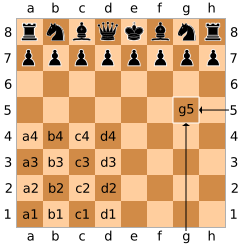
The letters run left to right across the board, from a to h, starting from White's left side. These vertical columns are called files.
The numbers run bottom to top, from 1 to 8, starting from White's side. These horizontal rows are called ranks.
So every square is simply a letter plus a number. The bottom-left corner from White's perspective is a1. The top-right corner is h8. Take g5 - that's column g, fifth row up. Once you see it on the board, it's instantly readable:
A quick trick to remember it - always read the letter first, then the number. Like reading a map - across first, then up.
The Pieces - What Each One Is Called
Each piece has a one-letter abbreviation in English - other languages use different letters, and many books and apps use small icons instead. Either way, the system works the same:
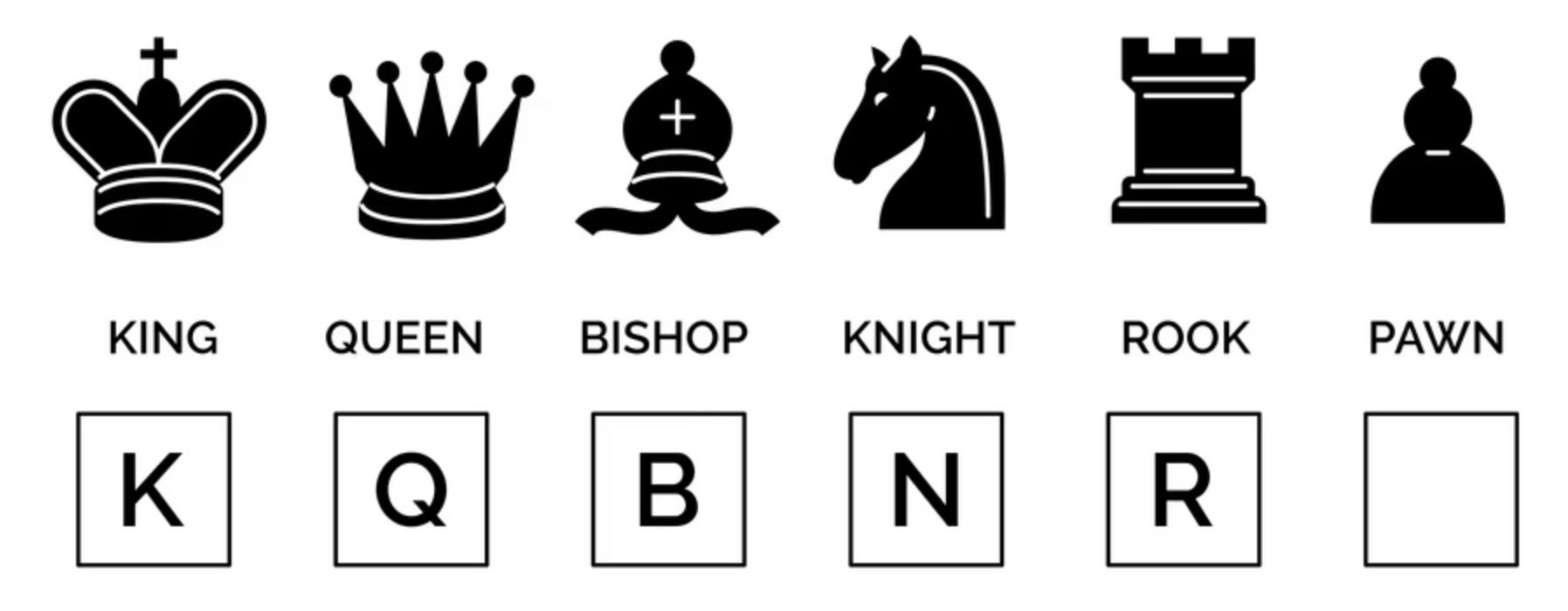
Six pieces, five letters. The only surprise is the Knight - it goes by N, because K already belongs to the King. Royal privilege!
One piece has no letter at all - the pawn. With eight of them on the board, they don't need an introduction.
How to Write a Move
A move is simply the piece's letter followed by the square it lands on.
So Nf3 means the Knight (N) moves to square f3.
Qd5 means the Queen moves to d5.
Rb1 means the Rook moves to b1.
Pawns are the exception - since they have no letter, you just write the square.
e4 means a pawn moves to e4 and d5 means a pawn moves to d5.
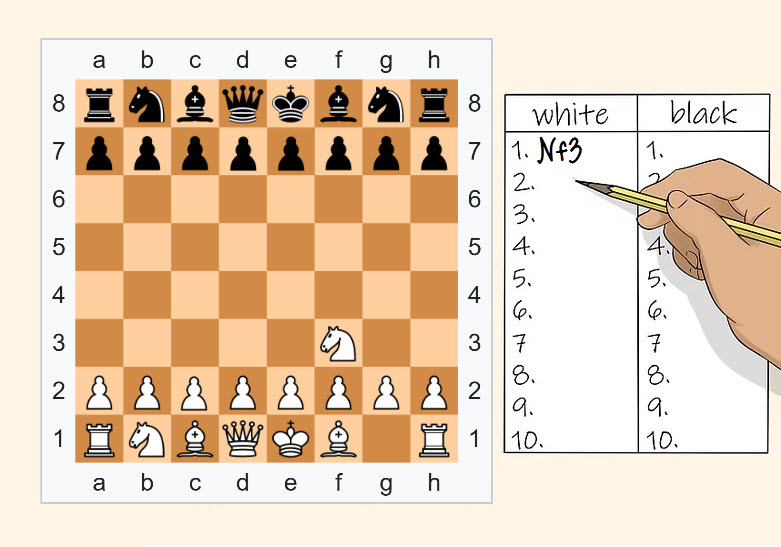
Most of the time, that's all you need. The only twist is when something is already standing on that square. In that case, you add an x to show a capture.
Nxf3 means the Knight takes whatever is on f3.
For pawns, captures look slightly different - you add the file the pawn started on. exd5 means the pawn came from the e file and captured on d5.
Extra Credit: Sometimes (rarely) two identical pieces can move to the same square - typically two knights or two rooks. In that case, you add the file the piece came from to clarify. If both rooks can move to d1, you write Rad1 (= the rook on the a file) or if they're on the same file, use the rank number instead - eg. R3d1 (= the rook on the rank 3).
The Tricky Three Moves
Chess has three moves that look a little different on paper - mostly because they're a little different on the board too! If you're not familiar with them yet, we've explained all three in detail in our Beginner's Guide.
Castling Kingside castling is written 0-0. Queenside castling is 0-0-0. The more zeros, the longer the castle.
Promotion When a pawn reaches the other end and promotes, you write the square and the piece it becomes. e8=Q means the pawn reached e8 and became a Queen (most of the time, it's a Queen).
En passant Still written like a normal pawn capture - just add e.p. at the end if you want to be specific. exd6 e.p. means the pawn captured en passant on d6.
The Last Pieces of the Puzzle
When the King is in danger, chess thinks it's important enough to mark.
Check - + When your move puts the opponent's King in check, add a + at the end. Qd5+ means the Queen moved to d5 and the King is now in check.
Checkmate - # The best symbol in chess. Qd5# means the Queen moved to d5 - and the game is over.
Putting It All Together
Now that you know the symbols, here's where they live - the scoresheet.
A scoresheet is simply a printed sheet with two columns - one for White's moves, one for Black's. Every move gets a number. White goes first, Black responds. That's the whole format.
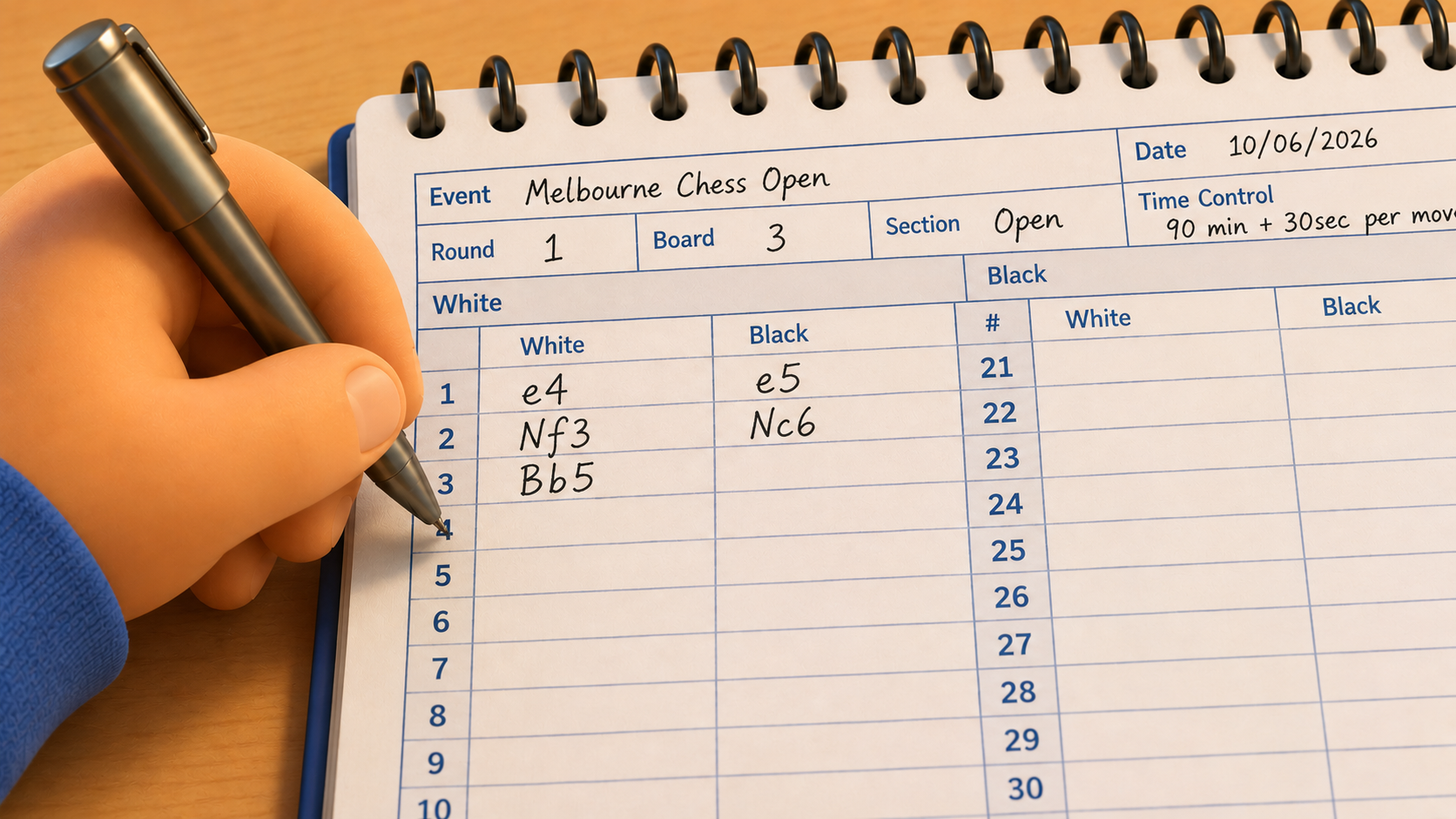
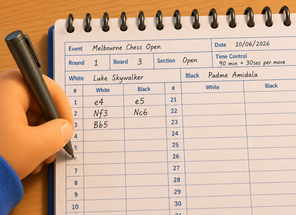
Basic Scoresheet with moves
These are the first three moves of the Ruy Lopez - one of the oldest and most played openings in chess history:
- White opens with a pawn to e4
- Black mirrors it, e5
- White's Knight goes to f3
- Black's Knight to c6
- White's Bishop pins the Knight on b5
A conversation between two players that chess enthusiasts have been having for over 500 years.
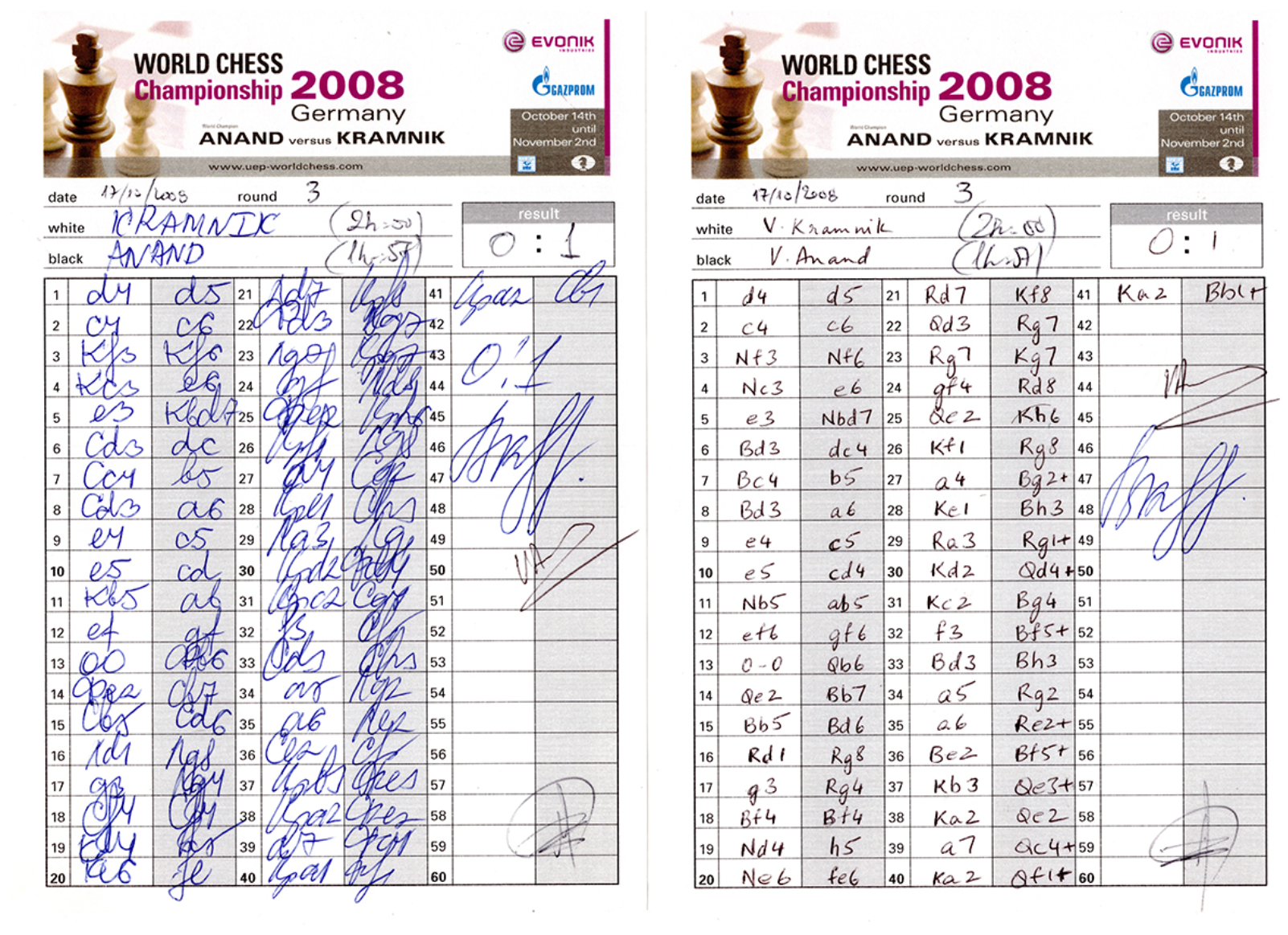
Example from FIDE museum - World Championship Match between Anand and Kramnik
If you ever sit down for a club game or a tournament, you'll be handed one of these before you start. At the end of the game, you mark the final score (1-0 means White won, 0-1 means Black won, and ½-½ is a draw) and both players sign to confirm the result . So a guaranteed autograph if you're lucky enough to play someone famous :)
If you want to keep all your games in one place, a scorebook is the way to go. We stock two options right here - simple one and fancy one that can hold 100 games.
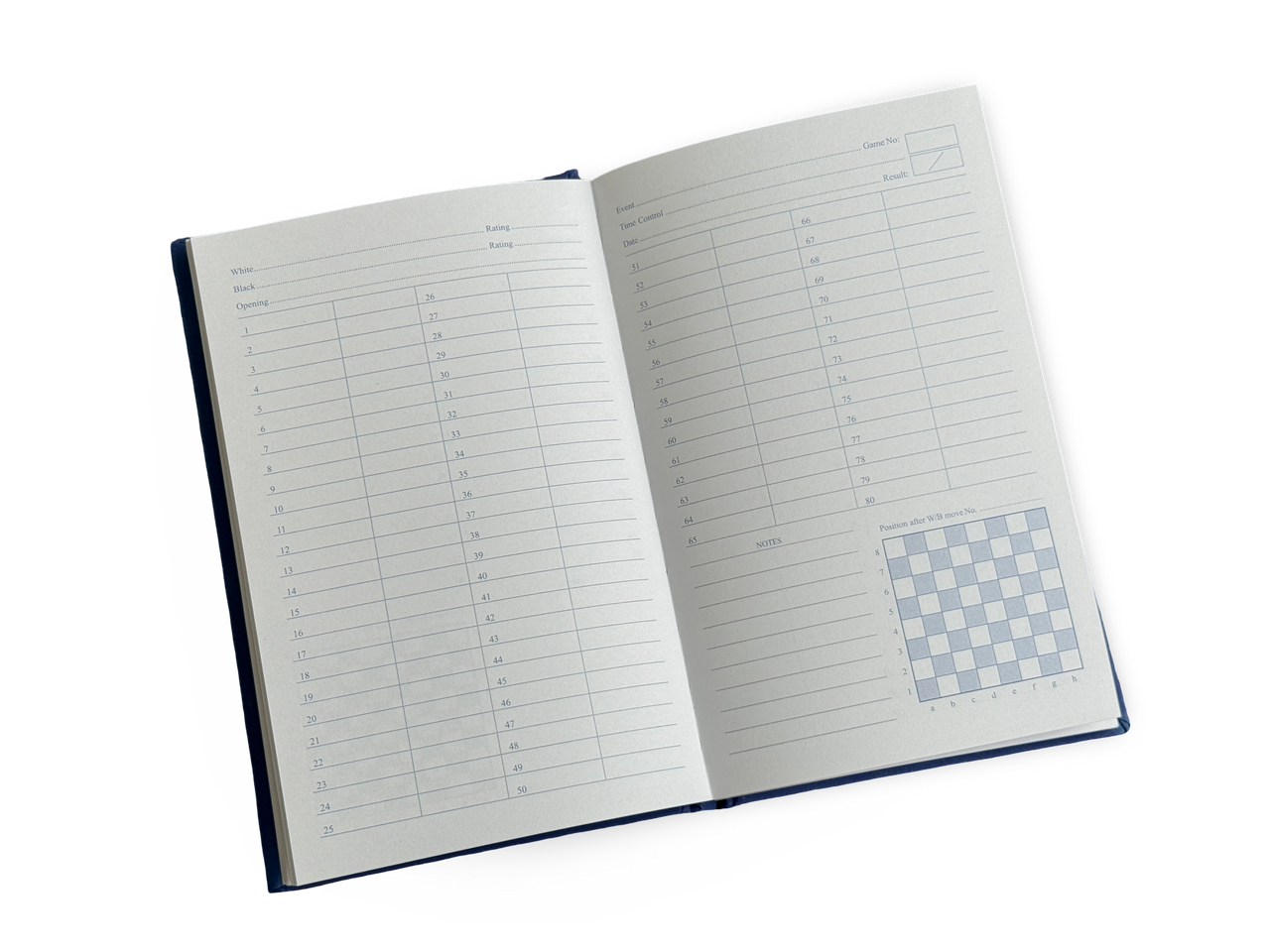
Hardcover Chess Score Book
What Is It All For?
Writing down your moves might feel like extra work at first - especially when you're focused on not blundering your Queen. But it's one of the most valuable things you can do as a developing player.
When the game is over, your scoresheet is a complete record of everything that happened. You can sit down afterwards, replay every move, and find exactly where things went right - or wrong. Most players improve fastest not by playing more games, but by understanding the ones they've already played.
It's also how chess has survived and grown for centuries. Every great game ever played has been preserved this way. The moves Fischer played in Reykjavik in 1972 are as accessible today as they were the day he played them. You can replay them, study them, learn from them. You can pick up any chess book, follow any commentary - the whole chess world opens up.
Chess isn't just a sport - it's an art form. As grandmaster Tartakower once put it, "Chess is an art appearing in the form of a game." A beautiful game deserves to be preserved, studied, and admired long after the final move. Notation is how that happens.
Modern electronic boards used in top-level tournaments can record moves automatically - but players are still required to write them down by hand. No exceptions. The rules are the rules.
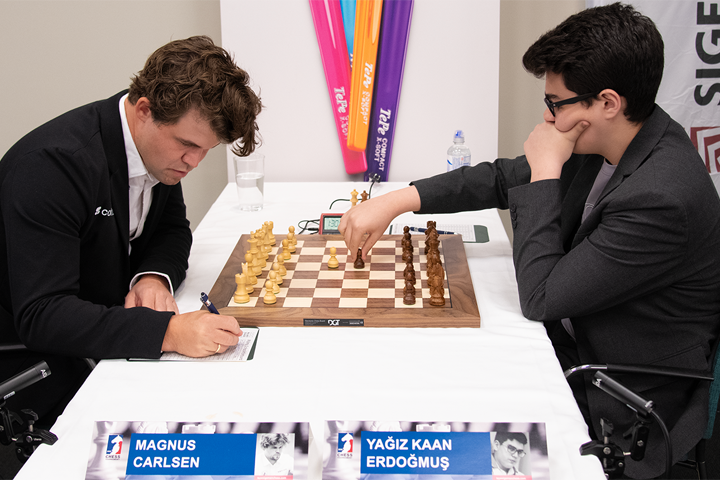
World No. 1 player writing down into his scoresheet - in a serious game, you are only allowed to make your next move after you've written down your previous one.
Pro Tips for You
The moves are the main event, but a scoresheet captures more than just what happened on the board.
At the top you'll fill in the basics - your name, your opponent's name, the event, the date, and which colour you're playing. Simple stuff, but important if you're keeping records over time.
In timed games, some players note how much time they used on key moves. Not required, but useful for understanding where you spent - or wasted - your clock. Your coach will thank you.
If your opponent offers a draw, mark it with (=) on that move. Simple way to keep track of what was offered and when.
In chess books and online commentary, you'll often see moves annotated with symbols like ! for a brilliant move, ? for a mistake, !! for something stunning, or !? for a risky but interesting idea. Commentators use these to tell the story of a game without words.
Finally - in serious tournament play, your scoresheet is evidence. If you want to claim a threefold repetition or another rule-based draw, the arbiter will ask to see it. A complete, accurate scoresheet is your proof. Keep it tidy and do not add anything that doesn't belong there.
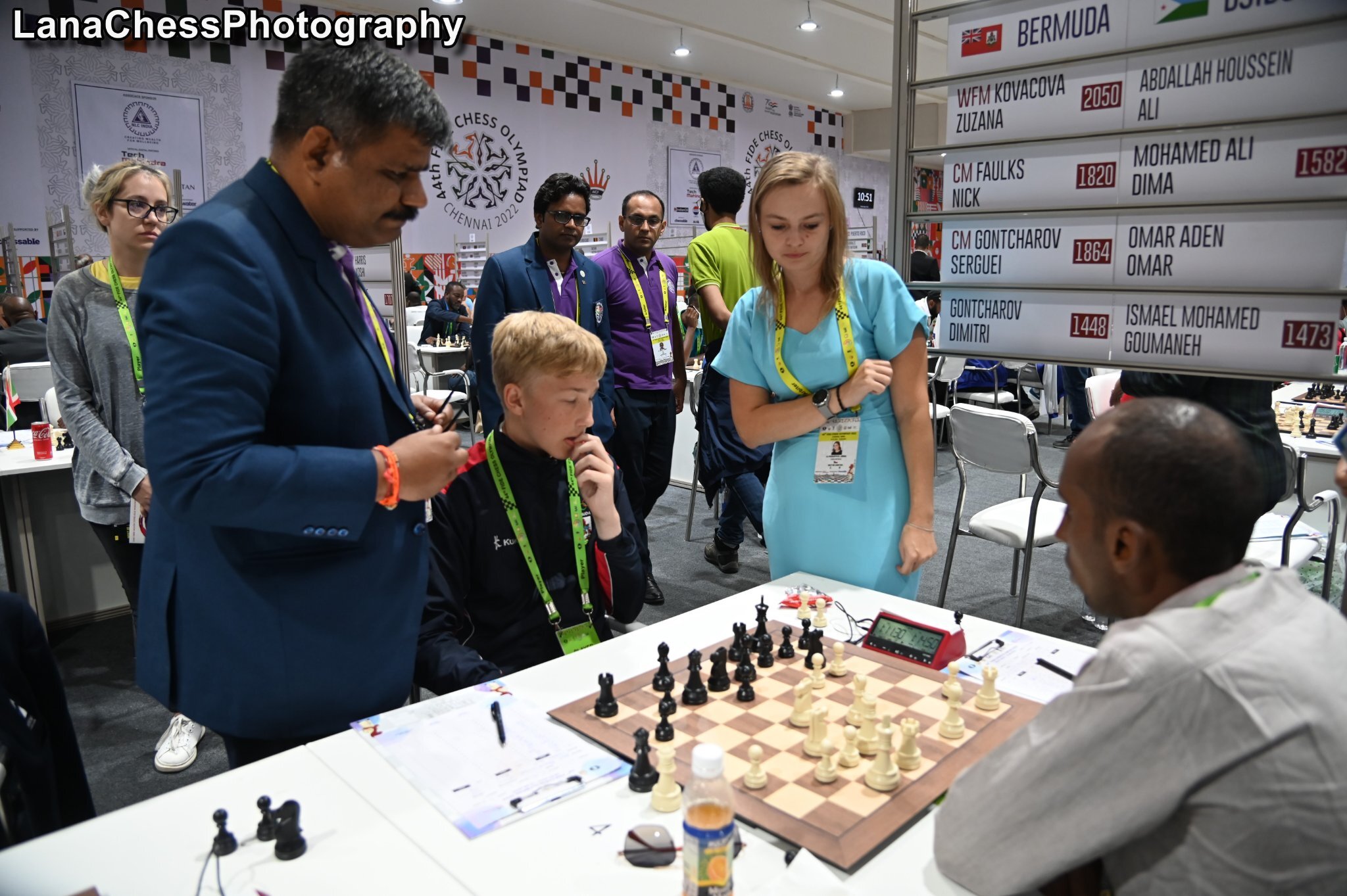
That's me acting as arbiter at a Chess Olympiad - The player had a claim - good thing they kept their scoresheet :)
Ready to Play?
Now you can read and write every move, follow any game ever played, and walk into a tournament knowing exactly what to do with that scoresheet.

Popular Classic Flip Combo – Chess & Checkers comes with notation
All that's left is a set worthy of the games you're about to record. Some chess sets come with the notation printed on the board itself - handy when you're still getting used to the coordinates. You'll find those in our tournament sets section or just tournament boards section. If those are not right for you check out this popular travel set.
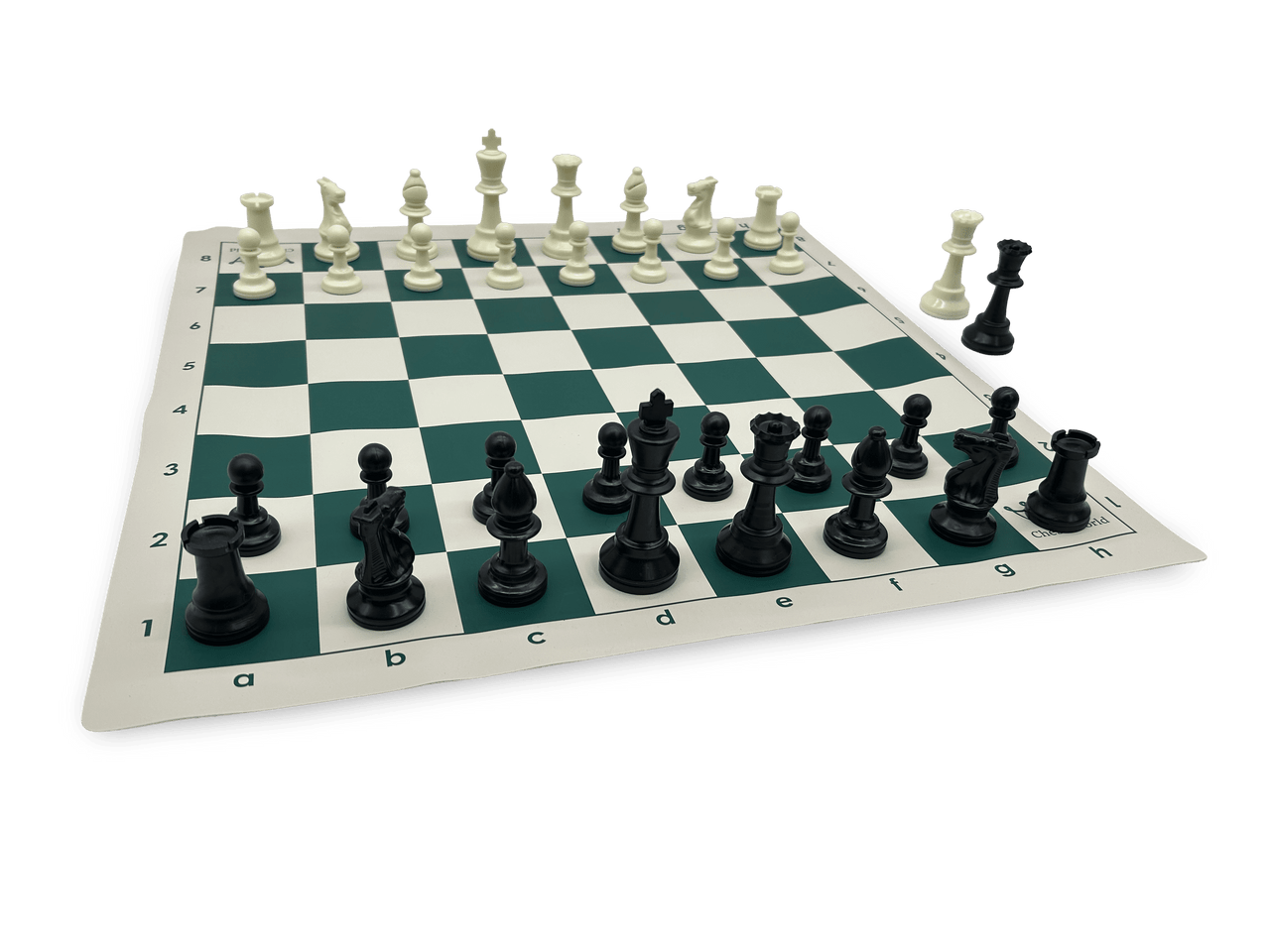
Tournament Pro Chess Set
P. S. Chess hasn't always used this system. The older descriptive notation - still found in some classic English chess books - described each square from the perspective of the piece moving, rather than a fixed coordinate. So e4 became P-K4, meaning "Pawn to the fourth square on the King's file." Every square had two names depending on which side you were playing from - what White called K4, Black called K5. Confusing, slow, and easy to misread. Algebraic notation took over for good reason! You can also sometimes hear it in movies or in The Queen's Gambit series.