




Article: Inlaid or Solid Timber? How to Choose a Wooden Chess Board
Inlaid or Solid Timber? How to Choose a Wooden Chess Board

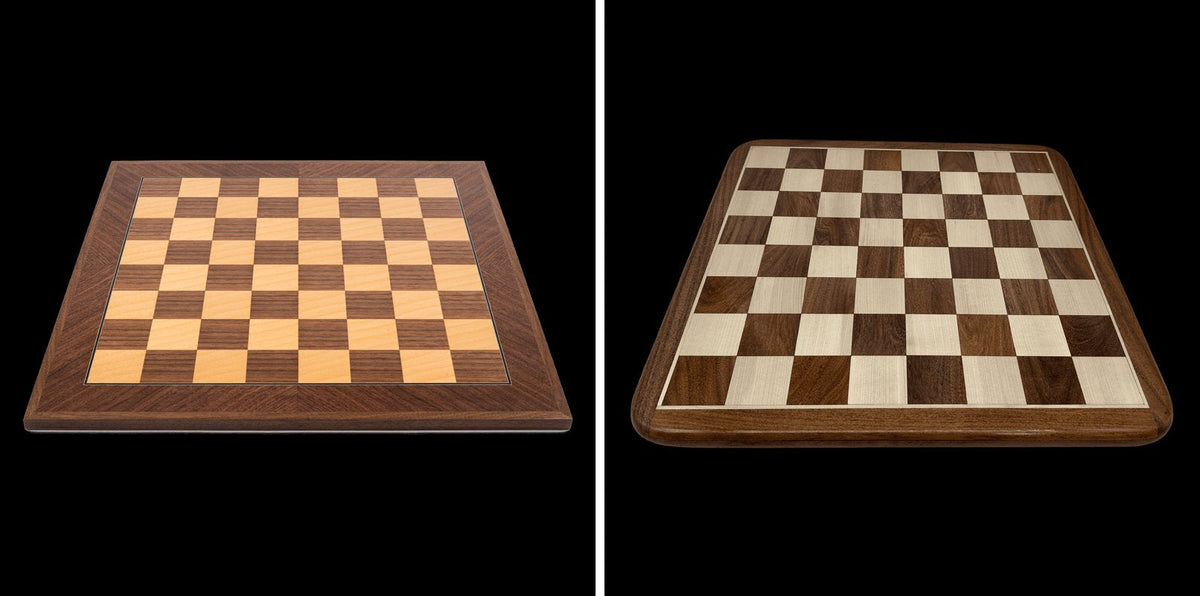
Two wooden chess boards, two very different ways of building one. Left: the Ferrer Walnut Chessboard Deluxe (inlaid). Right: the Rex Noir Solid Timber Acacia Chessboard.
There is no such thing as a chessboard cut from a single piece of wood.
Trees, sadly, do not grow in alternating light and dark squares. So every wooden chess board you have ever played on is made of at least 64 separate pieces of timber - more once you count the frame.
The real question is how deep those squares go.
Some boards set a layer of real wood into a base, like tiles laid into a floor. Others are timber all the way through, top to bottom. Both are real wood. Both can be beautiful. But they look, feel and age differently - and once you know where to look, you can tell them apart in about ten seconds.
You only need to check three places.
In this article, you will learn:
- What "inlaid" and "solid timber" actually mean on a wooden chess board
- The three parts of a board that give the game away
- Why a matte board and a gloss board feel so different under a lamp
- Which type suits a living room, a club, or a set you already own
- How to look after a wooden chess board so it lasts
What is an inlaid chess board?
On an inlaid chess board, each square is its own piece of real wood veneer - a thin layer of timber, cut to size and set into the board. Light and dark woods sit side by side, and the result is a smooth, flat playing field where the grain of every square is visible.
Our inlaid boards come from Ferrer, a family workshop near Barcelona that has been making chessboards since the early 1960s. They are sealed with a soft matte varnish, so the grain shows through without shine. The range covers several timbers, from the warm walnut chessboard to the dark wenge chessboard and the red-brown mahogany chessboard.
Because every square is cut separately, no two inlaid boards match exactly. That is not a flaw. That is the wood.

Every square on a Ferrer board is a separate piece of timber - which is why the grain changes from square to square.
What is a solid timber chess board?
A solid timber chess board is wood all the way through. There is no base underneath and no surface layer on top - the squares you see are the board.
Our solid timber boards are made by Rex Noir in Amritsar, India. You can choose an acacia chessboard with dark acacia and light maple squares, or an ebony chessboard with ebony against pale maple. Either way, the colour is the wood's own rather than a stain.
Solid timber boards are heavier for their size. Pick one up and you'll notice straight away.
And that weight is exactly the point.

The Rex Noir Solid Timber Ebony Chessboard: ebony squares on pale maple, timber all the way through - and no two boards share the same grain.
Check #1: The playing surface
Start where the pieces go.
Look at the grain. On both types, the grain should run naturally through each square and change slightly from one square to the next. If every square looks identical, like a printed pattern, you are probably looking at a photo of wood rather than wood.
Look at the finish. This is where wooden chess boards differ most in daily play:
- Matte (Ferrer boards, and most Rex Noir solid timber boards) - soft, low-glare and kind to the eyes under a lamp or a window. If you play long games in the evening, this matters more than you'd think.
- High gloss (the Acacia Rex Noir Solid Timber Chessboard Deluxe) - the pieces reflect in the surface and the board catches the light in the room. It is a showpiece look, made for a board that stays out between games.
Look at the lines. Some boards add a fine border line between the squares and the frame. The Ferrer Wenge Deluxe has a fine light line around its dark playing field; the Rex Noir acacia chessboard has a fine pale line framing the squares. It sounds like a tiny detail, but it is what makes the field of play "read" clearly from your chair.
Pro tip: check the square size against your pieces before you fall in love with the grain. Four pawns should fit on one square - FIDE's own rule. Our guide What Size Chessboard Do I Need? explains the four-pawn test in full.

Two finishes. The Ferrer Wenge Deluxe (left) has a soft matte varnish; the Acacia Rex Noir Deluxe (right) has a high gloss that catches the light.
Check #2: The board edge
Now turn your attention to the sides. The edge is where a board tells you how it was built - and it is the part people look at from across the room.
On an inlaid board, the frame is its own feature. Ferrer's signature is a diagonal frame: on the Walnut Deluxe, the walnut runs corner to corner around the squares, so the board looks the same from every seat at the table. On the Wenge Deluxe, the frame matches the deep brown of the dark squares.
On a solid timber board, look for how the edge has been shaped. The Rex Noir acacia and ebony chessboards have edges rounded and smoothed all the way round, so they look finished from every side. The Acacia Deluxe goes further, with a moulded acacia frame shaped like the edge of a good table - it has the profile of a piece of furniture rather than a game board.
A quick test: run your finger along the edge. A good board feels smooth and even, with no sharp corners to catch a sleeve.
(Also a good excuse to touch the nice boards in a shop without looking suspicious.)

Left to right: Ferrer's diagonal walnut frame, the rounded edge of the Rex Noir acacia chessboard, and the moulded acacia frame of the Rex Noir Deluxe.
Check #3: The underside
Flip it over. Most people never do - and it is the part that protects your table.
Felt is the thing to look for. Our Rex Noir solid timber boards - the acacia, ebony and Acacia Deluxe - all have green felt underneath, which stops the board scratching your table and keeps it from sliding when someone gets excited about a sacrifice.
The underside also matters if you want the board engraved. Many of our Ferrer and Rex Noir boards can be engraved, and on the Ferrer Wenge Deluxe you can choose the border, a square or underneath. Underneath is the quiet option - the message is there for whoever turns the board over in twenty years.

Flip them over: green felt under the Rex Noir acacia (left) and ebony (right) chessboards protects the table and keeps the board steady mid-game.
Inlaid or solid timber: which wooden chess board should you choose?
Here is the honest answer: neither is "better". They are built for different jobs.
Choose an inlaid Ferrer board if:
- You want real timber at a gentler price - the Ferrer Walnut Chessboard is the board we suggest for exactly that, and one of our best sellers
- You like a matte finish and a classic look
- You need a board that is easy to carry to the table and put away again
Choose a solid timber Rex Noir board if:
- You want weight - a board that stays exactly where you set it
- You already own good wooden pieces that deserve a better stage
- The board will live out on display between games
Think of it like the difference between a good pair of everyday boots and a pair of dress shoes. Both are proper leather. You'd just wear them to different places.
How to look after a wooden chess board
Whichever you choose, real wood asks for a little respect:
- Keep it out of direct sun - strong sunlight can fade or darken timber over time
- Keep it away from heaters and air-conditioner vents - all timber responds to changes in heat and humidity
- Wipe with a soft, dry cloth - skip sprays and polishes unless the maker recommends them
- Store it flat - and if it lives in a cupboard, don't stack heavy things on top
That's it. Do those four things and a wooden board will outlast most of the people who play on it.
Quick answers before you buy
Is an inlaid chess board real wood?
Yes. On our inlaid boards, every square is a real wood veneer - a thin layer of timber set into the board. It is real wood on the surface, built on a base rather than solid all the way through.
Is a solid timber chess board better than an inlaid one?
Not better, just different. Solid timber is heavier and stays put; inlaid boards are lighter, easier to move and usually gentler on the budget. Choose by how you will use the board.
How can I tell if a wooden chess board is solid timber?
Check three places: the playing surface, the edge and the underside. A solid timber board is wood all the way through and feels heavy for its size. If you're not sure, ask us - we'll tell you how a board is made.
What size wooden chess board do I need?
Match the square to your pieces, not the outside size of the board. Four pawns should fit on one square. Our chessboard size guide walks you through it.
The board is half the set
People spend a long time choosing chess pieces. They inspect the knight, compare the kings, weigh the pawns in their hand.
Then they put them on whatever board came free.

The Ferrer Walnut Chessboard - real inlaid timber, and the board we suggest when someone wants wood at a gentle price.
But the board is the part you look at for the whole game. It is the thing on the table when no one is playing. Get it right and an ordinary evening game starts to feel like an occasion - no grandmaster title required.
If you are new to wooden sets, our Top 5 Picks For Your First Chessboard is a good place to start. And if you want help matching a board to pieces you already own, just ask us.
We've been helping Australians find their perfect chess set since 1994 - and we're pretty good at it.
→ Wood Inlaid Boards - every square its own piece of timber
→ Solid Timber Boards - wood all the way through
→ Chess Boards - every surface, size and style we stock
→ Wooden Sets - the "proper" chess sets