




Article: What Size Chessboard Do I Need? The Four-Pawn Test and Other Measurements That Matter
What Size Chessboard Do I Need? The Four-Pawn Test and Other Measurements That Matter

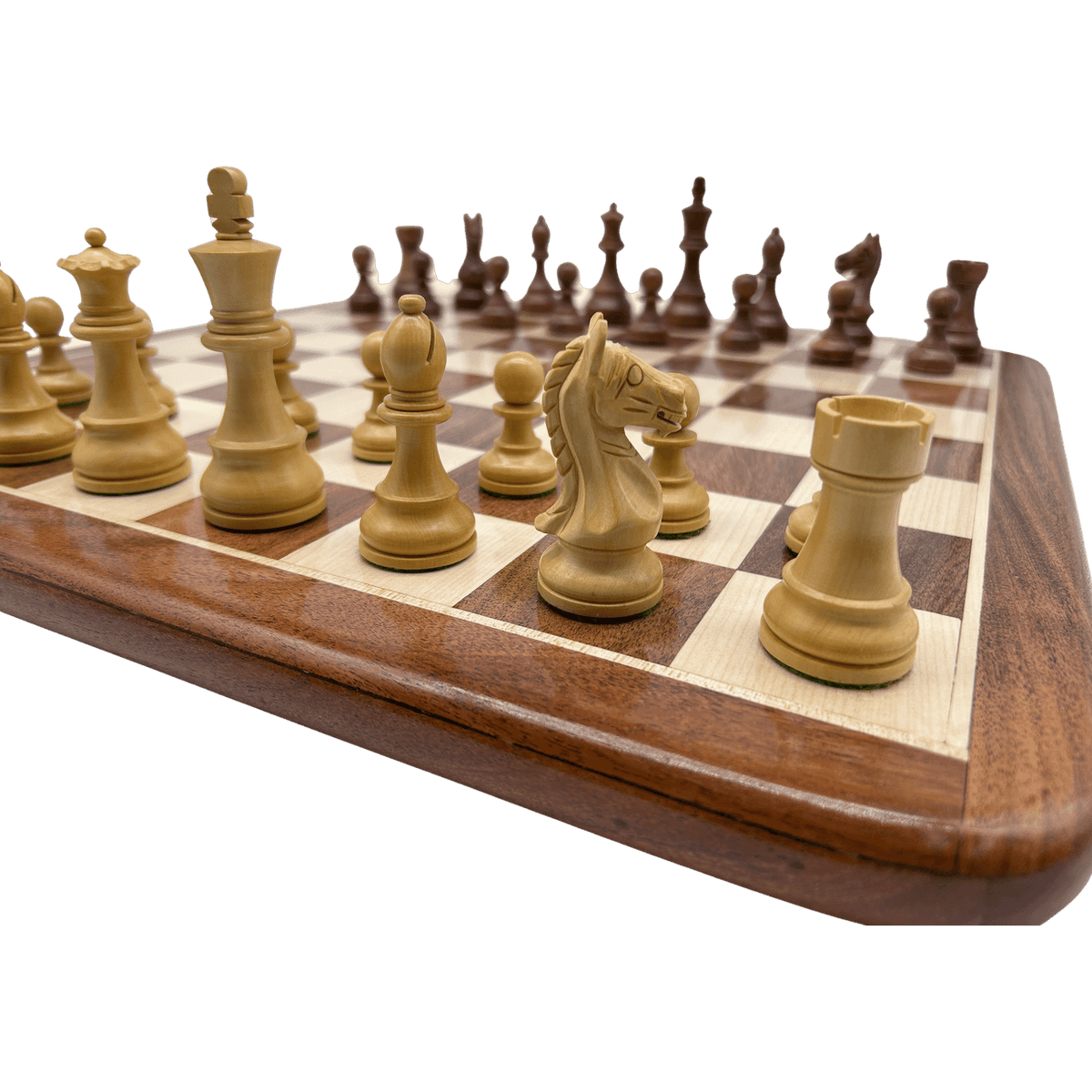
The Paris Classic. King height, square size and board size each tell you something different - and you need all three.
There is an official rule about how big a chess square should be. And it involves pawns.
FIDE, the international chess federation, says four pawns should fit on one square. It is not a party trick - it sits in FIDE's standards for tournament equipment, right next to the recommended height of the king (9.5 cm, if you were wondering).
It is also a surprisingly useful test at home. Because the most common sizing mistake is not a board that is too big for the table. It is pieces that are too big for the squares.
Photos online make this hard to spot. A picture shows the wood, the colour and the shape of the knight. It does not show how crowded the board feels with 32 pieces on it, when you are trying to pick up a bishop without knocking over its neighbours.
So let's do what an arbiter would do and get the measurements out. We'll use three of our Rex Noir sets along the way - the London Classic, Paris Classic and Paris Noir.
In this article, you will learn:
- What king height and king base each tell you, and why you need both
- How to measure a square properly, and why board size alone can fool you
- How to check a set against FIDE's tournament standards
- How much room a king needs on its square
- How much table a 50 cm board actually needs
- How to match new pieces to a board you already own
Why does one king need two measurements?
King height is the first number on most listings, and it is a good quick read on scale. A 95 mm king stands 9.5 cm tall, from the bottom of its base to the top of its cross. That is the size the Standard versions of our Rex Noir sets are built around.
But height only tells you how tall the pieces are. To know how they sit on a square, you also need the king base - the diameter across the bottom of the piece at its widest point. The king has the widest base in the set, so if the king fits comfortably, the rest of the army will too.
Picture two kings of the same height. Give one a wider base and it fills more of its square. Same height, more crowded board.
So read the two together. Height tells you how substantial the set looks. Base tells you how much room it takes up.

London Classic up close. Height gets the attention, but it is the base that decides how a piece sits on its square.
Is square size the same as board size?
No - and this is where a lot of online shoppers get caught.
Board size is the outside measurement, edge to edge, border included. It tells you how much table the board needs. Square size is the width of one playing square. It tells you how the pieces will fit.
To measure a square, lay a ruler along one side and measure from edge to edge. Leave the decorative border out of it.
Here is why that matters. Take a board sold as 50 cm. Divide 50 cm by eight and you would expect 62.5 mm squares. But the border takes its share first. If the squares are 55 mm, eight of them make a row 44 cm long, leaving 6 cm for the border - about 3 cm on each side.
That is why you cannot work out square size from the outside dimensions. Two boards of the same size can have quite different squares if one has a wider border, so if a listing does not give square size, ask us - or measure.

Paris Noir's ebony and maple board. The border sits outside the eight playing squares, so board size alone can't tell you square size.
What sizes do the Rex Noir sets come in?
The Paris Classic and Paris Noir come in two sizes, Standard and Compact. The London Classic comes in one. The Compact pieces are smaller and come with a smaller board, so check which size you have selected before you order - don't assume a Compact set shares the Standard figures just because it shares the name.
Want the exact square size or king base for a set before you buy? Send us a message and we'll measure it for you.
Did you know? FIDE's recommended piece heights are King 9.5 cm, Queen 8.5 cm, Bishop 7 cm, Knight 6 cm, Rook 5.5 cm and Pawn 5 cm. Each can vary by up to 10%, as long as the pieces stay in that order - a queen taller than her king is not allowed.
How do you compare a set with FIDE's standards?
FIDE's equipment standards recommend a king of about 9.5 cm, a base measuring 40 to 50% of a piece's height, squares of 5 to 6 cm, and room for four pawns on one square.
You can check any set against those numbers with a ruler and a calculator. Divide the king's base by its height: a 95 mm king with a 40 mm base comes out at 42%, inside the range. Then measure a square and see whether it falls between 50 and 60 mm.
Matching those proportions does not make a set FIDE-endorsed - endorsement is a separate approval that manufacturers apply for. But it does mean the set will feel familiar to anyone who has played on a club board.
How much room does the king need?
Put a king in the middle of its square and look at the gap around the base. Say the base is 40 mm and the square is 55 mm. Subtract one from the other and you have 15 mm to spare - about 7.5 mm on each side.
7.5 mm doesn't sound like much.
It is enough.
In the starting position every piece has a neighbour, and you reach between them all game. That small gap around each base is what lets your fingers in without the whole back rank wobbling.
Now for the four-pawn test. FIDE's rule means a square should be at least twice as wide as a pawn's base.
Got a set at home? Try it yourself: stand four pawns on one square. If they fit, the squares are generous enough for the pieces. If they spill well over the edges, the pieces are too big for the board.
The four-pawn test: FIDE's own rule of thumb, and the easiest sizing check you can do at home.
Don't judge everything by the king, though. Knights have never respected personal space - the carved head and mane can reach past the base, and they jump over everyone anyway. When you set up, give the knights a second look.

The Paris Classic knight. Its carved head reaches beyond its base, so check the knights as well as the king.
Then do the real test. Set up a full game, pick up a bishop from the back rank, play a pawn and put everything back. If your fingers find the pieces easily and you can tell them apart at a glance, the fit is right.
How much table space does a 50 cm board need?
More than 50 cm.
The board needs its full footprint, but a game spreads. Captured pieces need somewhere to go. A chess clock needs a spot beside the board (new to clocks? Here is why chess needs one). Add a drink and a scoresheet and the table fills fast.
FIDE has numbers for this too. Its tournament tables are about 110 cm long and 85 cm wide. Put a 50 cm board in the middle and each player gets 17.5 cm of table in front of them, with 30 cm either side of the board for the clock and the captured pieces.
You don't need a tournament table at home, but it is a handy benchmark. For a quick check, tape out a 50 cm square of paper where you plan to play and sit on both sides. Can each player reach the far squares comfortably? Where would the clock go?
Then think about what happens after the game. If the set lives on the dining table, where does it go when dinner arrives? And a set that looks lovely on a console table may not leave room for two chairs. Plenty of people keep the set on display and carry it to the table to play - which works well, as long as you have planned for it.

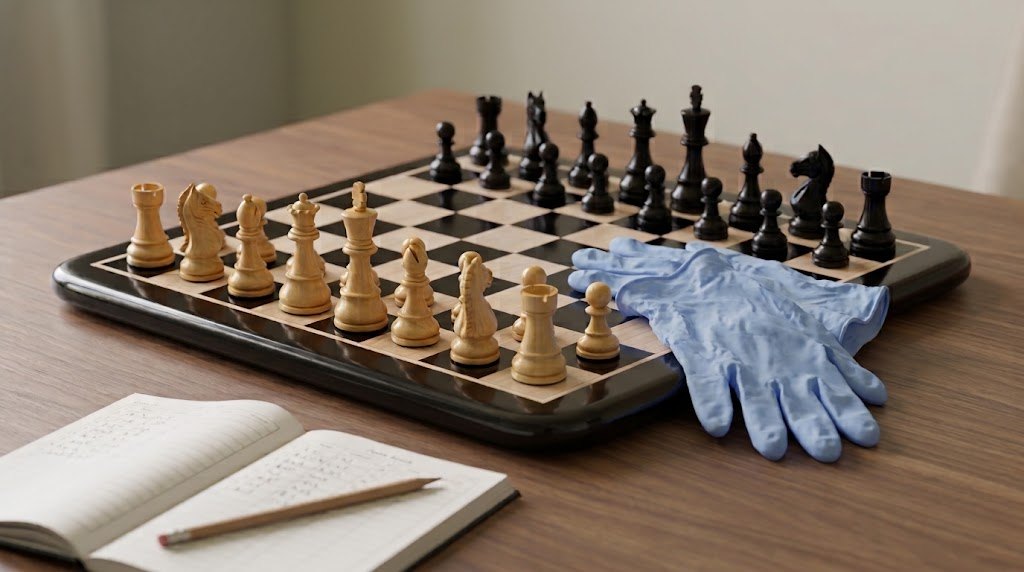
The London Classic in play position. The board needs its own footprint - a game needs a bit more.
Three sets, three different looks
Once the size is right, the choice comes down to looks.
London Classic pairs acacia and boxwood pieces with an acacia and maple board. Classic Staunton, with the simpler knight.
Paris Classic keeps the same warm brown and cream and the same timbers, but adds the more finely carved Paris knight.
Paris Noir goes darker: ebony and boxwood pieces on an ebony and maple board, with the detailed Paris knight.
Start with the full-set photo to see how board and pieces look together, then open the close-ups to compare each knight's face, mane and profile. More carving doesn't change the squares. It just changes what you will enjoy looking at between moves.
What comes in the box?
Check the product name before you order. Chess World sells boards and pieces separately as well as complete sets, and a photo showing both does not always mean a listing includes both.
The three complete sets here each list a board, 34 pieces including two spare queens, and a wooden storage box with foam. The pieces are double weighted, so they feel solid in the hand and stay put on the square.
The spare queens are for promotion, when a pawn reaches the far side of the board. You still set up 16 pieces each.
The box is for the pieces, so read its description separately from the board's. A storage box doesn't mean the board folds or fits inside it.

The London Classic's fitted wooden box, with a foam slot for every piece - spare queens included.
Matching new pieces to a board you already own
Start with a ruler. Write down the width of one square and the board's outside size, then compare them with the king height and king base on the pieces you are considering. Use the square to judge how the pieces will fit, and the outside size to judge the table space.
Keep everything in the same units. 40 mm and 4 cm are the same measurement, and so are 55 mm and 5.5 cm. Mixing them up is the fastest way to talk yourself into the wrong set.
It works the other way round too. If you own the pieces and want a new board, measure the king's height and base, then look for boards with the right square size. Our 50 cm boards are a good place to start for pieces with a 95 mm king.
Pro tip: the ruler is the most underrated chess accessory we don't sell :)
Still not sure? Send us the measurements, a photo of your board or pieces, and the product you are looking at, and we'll tell you whether they pair well. Our How to Choose a Chess Set guide is a good place to start, too.
Quick answers before you order
Does a 95 mm king always need a 50 cm board?
No. Height alone doesn't settle it - check the king base and the square size as well. A 50 cm board is a common partner for a 95 mm king, but the square size is what decides the fit.
Is square size the same as board size?
No. Square size measures one playing square. Board size measures the whole board, border included. You need square size to check the pieces fit, and board size to check the table.
Do Standard measurements apply to the Compact sets?
No. Compact sets have smaller pieces and a smaller board. Check the size you select, and ask us if you want exact figures.
What should I send if I want help matching a board and pieces?
Whatever you have of the square size, overall board size, king height and king base, plus the product name or link and a photo. That gives us something concrete to compare.
A set that fits
You will put your hands on a chess set thousands of times. It should fit the table, fit the squares and fit the way you live - and then it should make you want to sit down and play.
If this has you itching to set up a board, we'd love to help you find the right one. And if the new set is for someone just starting out, our Beginner's Guide will have them playing in an afternoon.
We've been helping Australians find their perfect chess set since 1994 - and we're pretty good at it.
→ Rex Noir - wooden sets done properly
→ Wooden Sets - the "proper" chess sets
→ Chess Boards - for when you already have the pieces
→ Chess Pieces - for when you already have the board