



Article: Does Playing Chess Make You a Better Surgeon?
Does Playing Chess Make You a Better Surgeon?
Chess and surgery have more in common than you might think - but maybe not in the way you'd expect.
In March 2023, a chess player lay awake on an operating table in Barcelona while surgeons worked on his brain.
Every so often, the team showed him a small chessboard and asked a simple question: is this move legal?
He wasn't being quizzed for fun. He had a tumour in the left side of his brain, close to areas he relied on to play, and he wished to protect his chess skills. So while the surgeons stimulated different spots with an electrode, he judged the moves. When they reached one particular point - a region called the supramarginal gyrus - he suddenly couldn't tell whether a move was allowed.
They left that spot alone.
Four months later, his ability to play was preserved - and so was his rating of 1950 Elo.
Surgeons had saved a chess player's chess. Now a group of surgeons is asking the opposite question: can playing chess make you a better surgeon?
The Surgeons Who Wrote About Chess
In early 2026, four surgeons from the University of São Paulo in Brazil - Ricardo Grillo and three colleagues - published a short article in the Journal of Oral and Maxillofacial Surgery. (Maxillofacial surgeons treat conditions of the mouth, jaws and face - think facial trauma and jaw reconstruction.)
The title? "The King Is in Check: How Playing Chess Can Be Useful to Surgeons."
It's worth being clear about what kind of article this is. It's a commentary - the authors sharing an idea - not a clinical trial. Nobody was tested and no patient outcomes were measured. But the idea is a fun one. They list seven skills that chess and surgery share:
- Strategic thinking and planning - in chess you predict what your move will lead to; in surgery you plan the approach and anticipate complications before the first cut.
- Precision and emotional control - chess doesn't train your hands, they admit, but it does train the focus and discipline to avoid impulsive decisions over hours of concentration.
- Spatial visualisation - strong players can picture the board in their head (even play blindfolded). Surgeons must picture anatomy in three dimensions before they operate.
- Pattern recognition - spotting a familiar pattern speeds up good decisions, whether it's a position on the board or a problem in the body.
- Training and critical review - chess players improve by going over their games and finding their mistakes. Surgeons improve through case reviews, simulations and constant learning.
- Risk management - every move has pros and cons. So does every surgical decision. It is the evaluation of your position that decides what to do.
- Emotional resilience - players used to fast games with a clock learn to stay clear-headed under time pressure. In an emergency, so must a surgeon.
Their neatest line sums it up: "Like a great master, surgeons do not improvise; they enter with a strategy."

Seven skills that the São Paulo surgeons say chess players and surgeons share.
A Chess Player's Guide to the Operating Theatre
The best part of the paper is a set of analogies that any chess player will recognise instantly.
The opening is surgical planning. A bad opening can ruin a whole game. In surgery, the scans, tests, surgical guides and choice of approach are the opening - get them wrong and everything after gets harder.
A fork is an unexpected complication. In chess, a fork is when one piece attacks two of yours at once, and you can't save both. The authors compare it to a complication that hits several things at the same time mid-operation. The surgeon, they write, must "escape the fork" with creativity and composure.
Check is a surgical alert. Sudden bleeding or a threat to a nerve is the operating theatre's version of check: you stop whatever you were planning and deal with it right now.
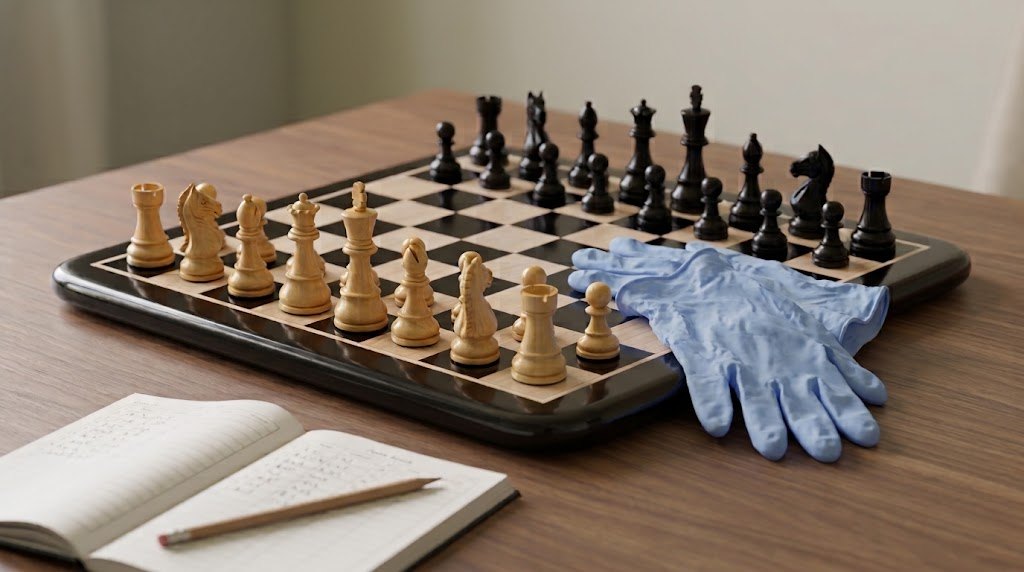
Checkmate is the silent victory. No celebrations, no fist pumps. Just a job done well, built on a long chain of correct decisions. As the authors put it: "In the end, the surgeon removes their gloves like a player closing the board."
It's a lovely image (although most chess players I know do celebrate a checkmate - at least a nice one).
So far, so convincing. But here's the thing.
Does Chess Actually Make You a Better Surgeon?
The surgeons answer this themselves, right at the end of their paper, and they're refreshingly honest about it:
"It is not a causal relationship. Playing chess does not make anyone a good surgeon, but the skills trained have clear parallels and can complement and enhance the refinement of technical and cognitive competencies."
In other words: the skills look alike, and they may support each other. But nobody has shown that learning chess turns a person into a better surgeon.
A proper test of the São Paulo idea would need to compare surgical trainees who learn chess with trainees who spend the same time on another engaging activity, then measure real surgical skills. Nobody has done that yet. The 2026 paper opens the question rather than answering it.
Fun fact: a small 2007 study of 33 surgeons in New York found that those who had regularly played video games made fewer errors in keyhole surgery drills. So if it's hands you're after, the evidence (such as it is) points to a games console, not a chessboard.
We'll try not to take it personally.
The Chess Habits That Really Carry Over
So is the whole idea just a nice metaphor? Not quite.
What chess trains, reliably, is a set of habits - and every game gives you instant feedback on them. You don't need to work in an operating theatre to practise these at your next game:
- Name your opponent's strongest reply before you move. A good plan should survive a serious answer.
- Compare two candidate moves. Don't fall in love with the first attractive idea. We are all guilty of that one.
- After the game, find the moment it turned. Check your reasoning, not just the result. As International Master Lukáš Vlasák told us in our pro coach interview, "take every game as a learning experience and opportunity to see what you need to improve." It's much easier if you record your moves - here's how to read and write chess notation.
- When the pressure rises, pause and look at the whole board again. A ticking clock or a fresh blunder is exactly when players rush. Taking a breath is a skill you can practise.
Will these habits jump from the board to the operating theatre on their own? You know they won’t. But they will make you a more thoughtful chess player - and that's a pretty good start.
Chess Is for Everyone
The popular image of chess is that it's a game for geniuses - for surgeons, scientists and people with enormous brains. Chess doesn't need a special kind of person, and it doesn't create one either. Magnus Carlsen, the best player of our time, once said: "I think you can be dumb and be fairly good at chess."
There you go - maybe there is still hope for me!
If you're new to the game, start with our Beginner's Guide to playing chess. It takes about two minutes to learn the moves. The rest is a lifetime of fun.
Ready to Play?
If this story has made you want to sit down across from someone and play, we'd love to help you find the perfect set. We've been doing just that since 1994:
→ Tournament Sets - all you need to play a game of chess
→ Chess Clocks - practise thinking clearly under time pressure
→ Magnetic Sets - small enough for the staff room or a quick game between shifts
→ Luxury Sets - a thank-you gift for the doctor in your life
References
- Grillo R, Brozoski MA, Melhem-Elias F, Deboni MCZ. The King Is in Check: How Playing Chess Can Be Useful to Surgeons. Journal of Oral and Maxillofacial Surgery. 2026;84:442-444. Read the paper (DOI)
- Cepero-Escribano V, Cerda-Company X, León-Cabrera P, et al. Can the knight capture the queen? The role of supramarginal gyrus in chess rule-retrieval as evidenced by a novel combined awake brain mapping and fMRI protocol. Cortex. 2024;178:235-244. Read the paper (DOI)
- Hospital Universitari de Bellvitge. Catalan researchers describe for the first time how to operate on a brain tumor while preserving the ability to play chess. Bellvitge Hospital news release
- Rosser JC Jr, Lynch PJ, Cuddihy L, et al. The impact of video games on training surgeons in the 21st century. Archives of Surgery. 2007;142(2):181-186.