



Article: What Is the Halloween Gambit? 3 Scary Chess Openings (And How to Survive Them)
What Is the Halloween Gambit? 3 Scary Chess Openings (And How to Survive Them)

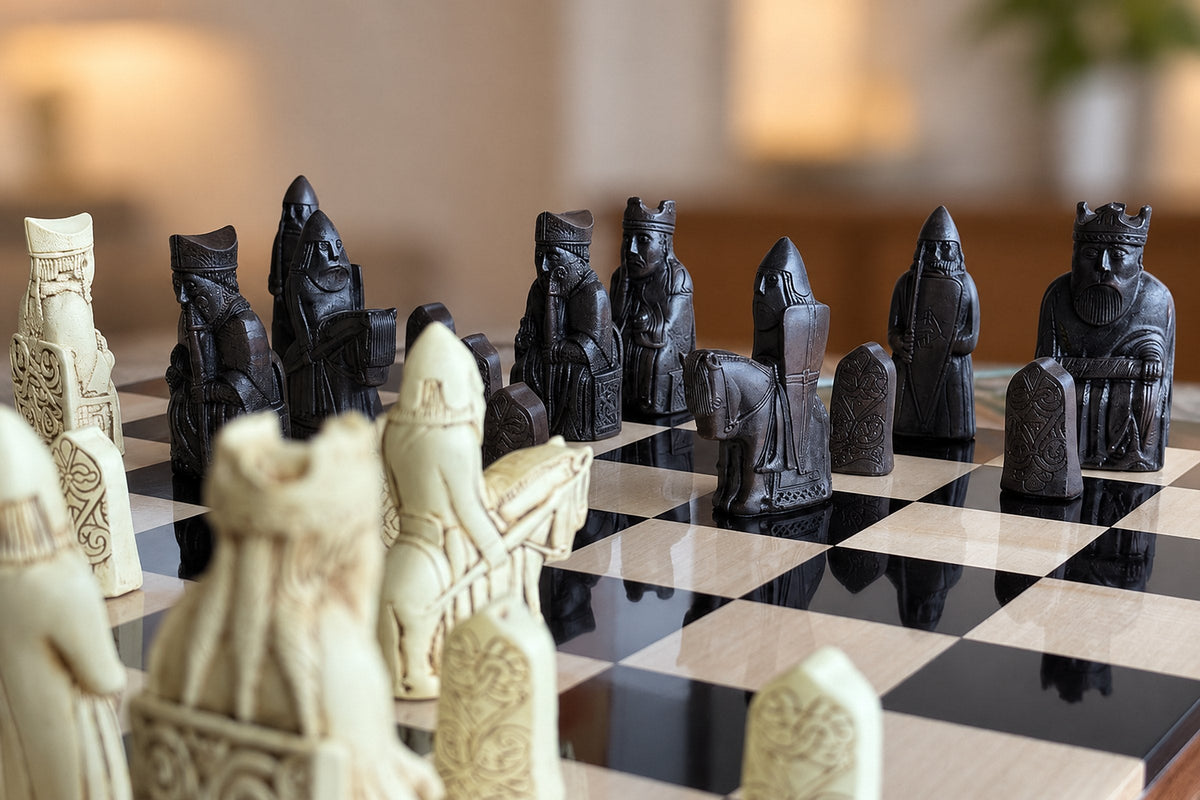
Our Black & White Marble Chess Set - suitably dramatic for Halloween.
On move four, White gives away a knight for a pawn.
No warning. No obvious trap. Just a perfectly good piece, handed over like a lolly at the door.
Strong players look at it and frown. Club players look at it and grin. And whoever is sitting across the board usually spends the next ten minutes wondering what they've missed.
That's the Halloween Gambit - and it's not the only chess opening with a name worthy of a horror film. Chess players have been giving their openings spooky, gruesome and frankly ridiculous names for centuries. Some of them are jokes. Some of them are warnings.
In this article, you'll learn:
- What the Halloween Gambit is, and why it got its name
- Whether the Halloween Gambit is actually any good
- The Vienna Game line named after Dracula and Frankenstein's monster
- What the Fried Liver Attack is, and why it's named after a liver dish
- How to stop the Fried Liver Attack if someone springs it on you
New to the move notation below? Our simple guide to reading chess notation will have you following along in five minutes.
What Is the Halloween Gambit in Chess?
The Halloween Gambit is a chess opening where White sacrifices a knight for a pawn on move four: 1.e4 e5 2.Nf3 Nc6 3.Nc3 Nf6 4.Nxe5. It's also known as the Müller-Schulze Gambit or the Leipzig Gambit.
It starts out as one of the calmest openings in chess, the Four Knights Game. Both players bring out their knights, everything is symmetrical, and nothing much happens.
Then White plays 4.Nxe5.
A knight takes a pawn, and Black simply takes the knight back. White is now a whole piece down for one pawn - a trade that would normally make any chess coach reach for a cup of tea and a lie-down.
But the idea is not to win the pawn. The idea is to win the centre. White follows up with d4 and pushes pawns down the middle of the board, chasing Black's knights backwards until they're tripping over each other. If Black panics, the attack comes fast.

Every Halloween Gambit starts from the quiet Four Knights Game - here on our Isle of Lewis Chess Set.

The Halloween Gambit after 4.Nxe5. White has just given up a knight for a single pawn - on purpose.
Who Named It the Halloween Gambit?
The opening is much older than its name. Back in 1888, chess writer Oskar Cordel noticed club players in Leipzig catching opponents out with it. He wasn't convinced, though. In his view, it simply shouldn't work.
The Leipzig players called it the "Gambit Müller und Schulze". There was no Müller and no Schulze. The names were a joke - the German version of calling it the "Joe Bloggs Gambit".
The spooky name came much later, from German player Steffen Jakob. His explanation:
"Many players are shocked, the way they would be frightened by a Halloween mask."
Which is exactly how it feels to face it.
Is the Halloween Gambit Good?
Against perfect defence, probably not. In a real game, it can be very dangerous.
In 2004, American chess author Larry Kaufman named the antidote: 4...Nxe5 5.d4 Nc6 6.d5 Bb4. He gave the credit for the idea to Polish International Master Jan Piński, who had dug deep into the main lines.
But "refuted" in a book and "refuted" at your kitchen table are two different things. Black has to find a precise sequence of moves while White throws pawns at them. The attack works far more often in real games than it should on paper.
So it's a bit like a haunted house. Once you know where the actors are hiding, it's not that scary. The first time through? You'll probably scream.

Most chess openings are judged by computers. The Halloween Gambit is judged by the look on your opponent's face.
What Is the Frankenstein-Dracula Variation?
If the Halloween Gambit is a jump scare, this one is a full monster movie.
The Frankenstein-Dracula Variation is a wild line of the Vienna Game where Black lets White's knight capture a rook in the corner in exchange for a fierce attack:
1.e4 e5 2.Nc3 Nf6 3.Bc4 Nxe4 4.Qh5 Nd6 5.Bb3 Nc6 6.Nb5 g6 7.Qf3 f5 8.Qd5 Qe7 9.Nxc7+ Kd8 10.Nxa8 b6
By move ten, White's knight has stormed into the corner and eaten Black's rook. Black's king has been chased off its home square. Both sides have abandoned all sense of safety.
Chess writer Tim Harding gave it its name in 1976. The play was so bloodthirsty, he wrote, that "a game between Dracula and the Frankenstein Monster would not seem out of place."

Costumes optional: our Emerald Medieval Knights Chess Set looks ready for a monster movie.

The Frankenstein-Dracula Variation after 10...b6. Black is a full rook down - and quite happy about it.
Why Would Black Give Up a Rook?
Because the knight on a8 is trapped.
It captured the rook, but it can't get back out. Sooner or later Black picks it up, and the material gap shrinks to almost nothing. Meanwhile, Black's pawns own the middle of the board, the bishops are itching to join in, and White's king is starting to sweat.
Played accurately, both sides have their chances. Is Black's attack really worth a whole rook? Chess writers still can't agree - which is chess-book code for "nobody knows".
And it's not just a club curiosity. Vassily Ivanchuk and Viswanathan Anand played it against each other in Roquebrune in 1992 (the game was drawn), and Daniil Dubov won with it in a rapid tie-break at the 2025 FIDE World Cup.
Monsters, it turns out, are welcome at the very top.
What Is the Fried Liver Attack?
The last opening on our list doesn't sound scary at all. It sounds like lunch.
The Fried Liver Attack is an attacking line of the Two Knights Defence where White sacrifices a knight on f7 to drag Black's king into the open:
1.e4 e5 2.Nf3 Nc6 3.Bc4 Nf6 4.Ng5 d5 5.exd5 Nxd5 6.Nxf7
If Black takes the knight with 6...Kxf7, White's queen jumps in with 7.Qf3+ and the king is pulled out into the middle of the board, where it's surrounded and very alone.

The Fried Liver is all about a knight landing on f7. Knights don't come much bolder than the ones in our Jade Royal Court set.

The Fried Liver Attack after 6.Nxf7. The knight sacrifice that has been ruining Black's day for over 400 years.
Why Is It Called the Fried Liver Attack?
The name comes from fegatelli, an Italian recipe where pieces of pork liver are bundled up in a lacy layer of fat and grilled over flames.
Picture Black's king getting the same treatment: trapped inside a web of White's pieces and cooked over a very hot fire.
It's also ancient. The oldest game we know of with this attack was played in Rome by the Italian master Giulio Cesare Polerio, some time before 1606. Players were frightening each other with it while Shakespeare was still writing plays.
How Do You Stop the Fried Liver Attack?
Don't walk into it.
After 4.Ng5 d5 5.exd5, the move 5...Nxd5 is the one that invites the attack. The calmer (and better) reply is 5...Na5. It hits White's bishop and stops the bonfire from ever being lit.
Nobody has ever proved that the Fried Liver wins by force. The catch is that attacking here is easy and defending is hard - and the less time you have, the harder it gets. In a quick game, the side with the scary plan often wins simply because the other side runs out of minutes.
Pro Tip: If someone plays 4.Ng5 against you at a party, answer 4...d5, and on 5.exd5 reach for 5...Na5. Then smile politely. It's much more unsettling than panicking.
Did You Know?
Alexander Alekhine - World Chess Champion from 1927 to 1935 and again from 1937 to 1946, and one of the most ferocious attacking players in history - was born on 31 October 1892.
A Halloween birthday for a player famous for scaring his opponents. You couldn't make it up.
Are Scary Chess Openings Worth Learning?
If you want to beat a computer, no. If you want to have fun, absolutely.
These openings are a reminder of something we love about chess: it's not a silent, serious game for geniuses in tweed. It's played by people who name their openings after monsters and offal. Who give away knights on move four just to see what happens. Who laugh when it works, and laugh even harder when it doesn't.
You don't need to memorise a single line of theory to enjoy chess. But learning one cheeky opening and trying it on a friend this Halloween? That's a very good way to start. (If the rules themselves are still new, our Beginner's Guide will have you playing in an afternoon.)
Scary Chess Openings: Quick Answers
What is the Halloween Gambit?
The Halloween Gambit is a chess opening where White sacrifices a knight for a pawn on move four: 1.e4 e5 2.Nf3 Nc6 3.Nc3 Nf6 4.Nxe5. White then uses central pawns to chase Black's knights and build an attack. It's also called the Müller-Schulze or Leipzig Gambit.
Is the Halloween Gambit a good opening?
Against accurate defence it's considered unsound - Larry Kaufman wrote in 2004 that 4...Nxe5 5.d4 Nc6 6.d5 Bb4 refutes it. In casual and club games, though, the attack can be very hard to defend.
What is the Frankenstein-Dracula Variation?
It's a sharp line of the Vienna Game (1.e4 e5 2.Nc3 Nf6 3.Bc4 Nxe4 4.Qh5) where White's knight captures Black's rook in the corner and Black gets a strong attack in return. Tim Harding named it in 1976.
What is the Fried Liver Attack?
The Fried Liver Attack is a line of the Two Knights Defence where White sacrifices a knight on f7: 1.e4 e5 2.Nf3 Nc6 3.Bc4 Nf6 4.Ng5 d5 5.exd5 Nxd5 6.Nxf7. It's named after fegatelli, an Italian liver dish.
How do you stop the Fried Liver Attack?
After 4.Ng5 d5 5.exd5, avoid 5...Nxd5 and play 5...Na5, which most experts recommend as Black's best move. It attacks White's bishop and avoids the knight sacrifice on f7 altogether.
Ready to Play?
If this has you itching to try the Halloween Gambit on someone, we'd love to help you find the right set to do it on. We've been helping Australians find their perfect chess set since 1994 - and we're pretty good at it.
→ Tournament Sets - never the wrong choice, scary openings included
→ Wooden Sets - the "proper" chess sets, beautiful by candlelight
→ Themed Sets - for when you want your pieces to look like they belong in a story
→ The Usborne Complete Book of Chess - a friendly place to start learning openings
Resources
- Halloween Gambit - move order, Leipzig origins, Oskar Cordel (1888), Steffen Jakob's naming quote, Larry Kaufman (2004) and Jan Piński's analysis.
- Vienna Game, Frankenstein-Dracula Variation - main line, Tim Harding's 1976 naming quote, assessment, Ivanchuk vs Anand (1992), Dubov (2025 FIDE World Cup).
- Fried Liver Attack - move order, the fegatelli name, Polerio (before 1606), 5...Na5 as Black's best defence.
- Alexander Alekhine - date of birth and World Championship years.
- How to Read and Write Chess Notation - how to follow the moves in this article.

Written by Joanna Prokopova