
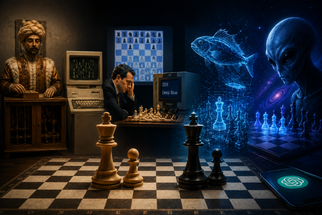
Posted by Joanna Prokopova on 9th Jul 2026
Why Is ChatGPT Bad at Chess?
You may have seen the headlines. Magnus Carlsen - the world's best chess player - beat ChatGPT without losing a single piece. ChatGPT then praised his play and estimated his rating at 1800. His actual rating is 2839. He captioned the post "I sometimes get bored while travelling."
It went viral. And it made ChatGPT look very, very bad at chess.
But here's what the headline missed - because while ChatGPT was struggling to play a legal game, chess engines like Stockfish were busy being completely unbeatable by any human alive. Both are artificial intelligence. Both run on computers. They couldn't be more different.
Humans have been obsessed with building a chess-playing machine for centuries. Long before computers existed, the idea that a machine could think - could calculate, could outwit a human mind - was both terrifying and irresistible. And chess was always the test.
The First Chess Computer Was a Lie
In 1770, a Viennese inventor unveiled what appeared to be the world's first chess-playing machine - a turbaned mechanical figure seated at a cabinet, capable of beating almost any opponent it faced. It toured Europe for decades, defeating Napoleon Bonaparte and Benjamin Franklin along the way.
If you've been following our blog, you already know how this one ends. If not - it's one of the best stories in chess history (read it here). It was a hoax. A human chess master was hidden inside the cabinet the entire time.
But the obsession it revealed was completely real. We wanted to build a thinking machine - and we wanted to prove it could play chess. It just took another two centuries to actually do it.
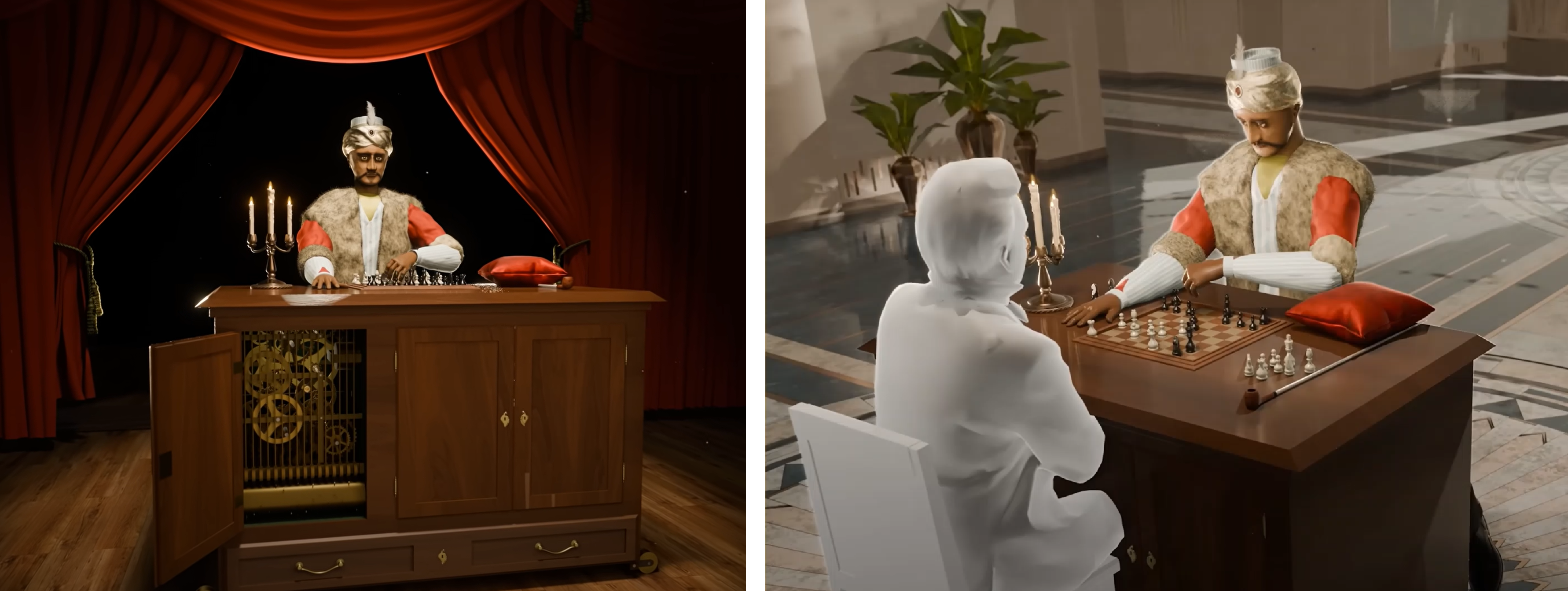
Modern Animations of the legendary Mechanical Turk (by Primal Space)
Early Chess Computers Were Terrible
When actual computers arrived in the 1950s, the first thing scientists wanted to do was teach them chess. Not because chess was useful - but because if a machine could master chess, it might be able to master anything. Chess was the ultimate test of machine intelligence.
The early results were not encouraging. The first chess programs could barely beat a beginner. Alan Turing - one of the founding fathers of computer science - designed a chess program in 1948 before he even had a computer to run it on. He tested it by hand, calculating each move himself on paper. It was slow, clunky, and not very good.
For decades, progress was steady but unspectacular. Computers got faster, programs got smarter, and by the 1980s a decent chess computer could beat a decent club player. But the world's best humans? Not even close.
Then IBM decided to do something about that.

The very first real chess machine - El Ajedrecista, built by Spanish engineer Leonardo Torres Quevedo in 1912 - could play a basic King and Rook endgame.
Deep Blue vs Kasparov - The Match That Shocked the World
By the 1990s, chess computers had become genuinely strong. But the world's best human player was still untouchable. Garry Kasparov - widely considered the greatest chess player who ever lived - had nothing to fear from a machine.
In 1996, IBM's supercomputer Deep Blue challenged him. Kasparov won the match 4-2. He was confident, dismissive even. Machines could calculate, he said. But they couldn't understand chess.
He came back in 1997 for a rematch. But this time... Deep Blue won.
It was the first time a reigning World Chess Champion had been defeated by a computer under tournament conditions. The world took notice. Newspapers that didn't normally cover chess led with it. It felt like something fundamental had shifted - not just in chess, but in what machines were capable of.
Kasparov was actually convinced IBM had cheated. One move in game two was so unexpectedly human that he demanded to see the computer's logs. IBM refused, declined a rematch, and dismantled Deep Blue shortly after. They eventually released the logs years later. The questions never fully went away.
What Deep Blue actually did was brute force calculation - evaluating up to 200 million positions per second. It wasn't thinking. It wasn't understanding chess. It was calculating faster than any human brain could follow. Kasparov wasn't beaten by intelligence. He was beaten by speed.

Garry Kasparov
Stockfish - When Computers Became Unbeatable
After Deep Blue, the race was over. Humans had lost. The only question was how much better computers could get.
The answer was: a lot.
Stockfish - the world's strongest traditional chess engine - can evaluate around 70 million positions per second. It plays at a level so far beyond any human that the comparison is almost meaningless. A rating of 2800 makes you one of the best humans who has ever lived. Stockfish's estimated rating is somewhere above 3500. No human alive can give it a serious game.
But here's what makes Stockfish interesting - it doesn't think. It calculates. It looks ahead using a search algorithm that intelligently prunes the vast majority of possible moves, evaluates the remaining positions using a trained neural network, and picks the best move. It's not exactly brute force - it's smarter than that. Just relentlessly, incomprehensibly good.
Chess players quickly realised that engines like Stockfish were too valuable to ignore. Today every serious player uses them - to prepare openings, to analyse games, to find mistakes. For the first time in history, world-class chess analysis was available to anyone with a laptop. You didn't need a library of books, an expensive coach, or a grandmaster in your corner. The engine that was supposed to kill chess made it more accessible than it had ever been.
But then something happened that made even Stockfish look ordinary.

Stockfish is a free and open-source chess engine, available for various desktop and mobile platforms.
The Machine That Taught Itself Chess in Four Hours
Deep Blue was programmed by humans. Stockfish was programmed by humans. Every chess engine before 2017 was built on rules, evaluations, and knowledge that humans had carefully coded in.
Then Google's DeepMind built AlphaZero.
AlphaZero was given one thing - the rules of chess. No openings, no strategy, no human knowledge of any kind. It was then left to play against itself. For four hours.
After four hours, it challenged Stockfish - at the time the strongest chess engine in the world - to a 100-game match. AlphaZero won 28 games. Stockfish won zero. The rest were draws.
But what stunned the chess world wasn't just the result. It was how AlphaZero played. It sacrificed pieces in ways that looked like mistakes but weren't. It built pressure slowly, patiently, over dozens of moves. It played with what chess players could only describe as intuition - and sometimes, beauty.
Grandmasters who had spent their careers studying the game said they had never seen anything like it. Some called it alien. Others said it played like the greatest human player who ever lived - except better.
What AlphaZero proved wasn't just that it could beat Stockfish. It proved that centuries of human chess knowledge - all those openings, all those principles, all those rules - were just one way to play the game. Not necessarily the best way.
AlphaZero's code was never made public - it remains Google's property. But the chess community built their own version. Leela Chess Zero - developed by volunteers around the world using the same self-learning approach - is now one of the strongest engines available, free for anyone to use.
So Why Can't ChatGPT Play Chess?
ChatGPT is not a chess engine like Stockfish or AlphaZero. It is a language model - trained on billions of words of text to predict what comes next in a conversation. It learned about chess by reading about it. Not by playing it.
Asking ChatGPT (or any chatbot) to play chess is like asking a sommelier to grow the grapes. They can tell you everything about the vineyard, describe every note in the glass, and recommend the perfect bottle for any occasion. But tasting and farming are completely different skills.
ChatGPT can explain the Sicilian Defence beautifully. It can tell you the history of every World Championship match ever played. It understands chess conceptually - but it has no way to actually track what's happening on the board. Every move, it has to reconstruct the entire position from memory, in text. It loses pieces. It makes illegal moves. It forgets what happened three moves ago. It is not a design flaw - growing grapes was never part of the sommelier's training.
Which brings us to Magnus Carlsen.
When the clickbaits read "Carlsen beats ChatGPT" - what they should have read was "Carlsen beats a language model that was never designed to play chess in the first place - and you can too." Stockfish would have beaten Magnus before he finished his orange juice. You can test it for yourself, but there are better ways to spend time!
I for one went straight to the source and asked :)
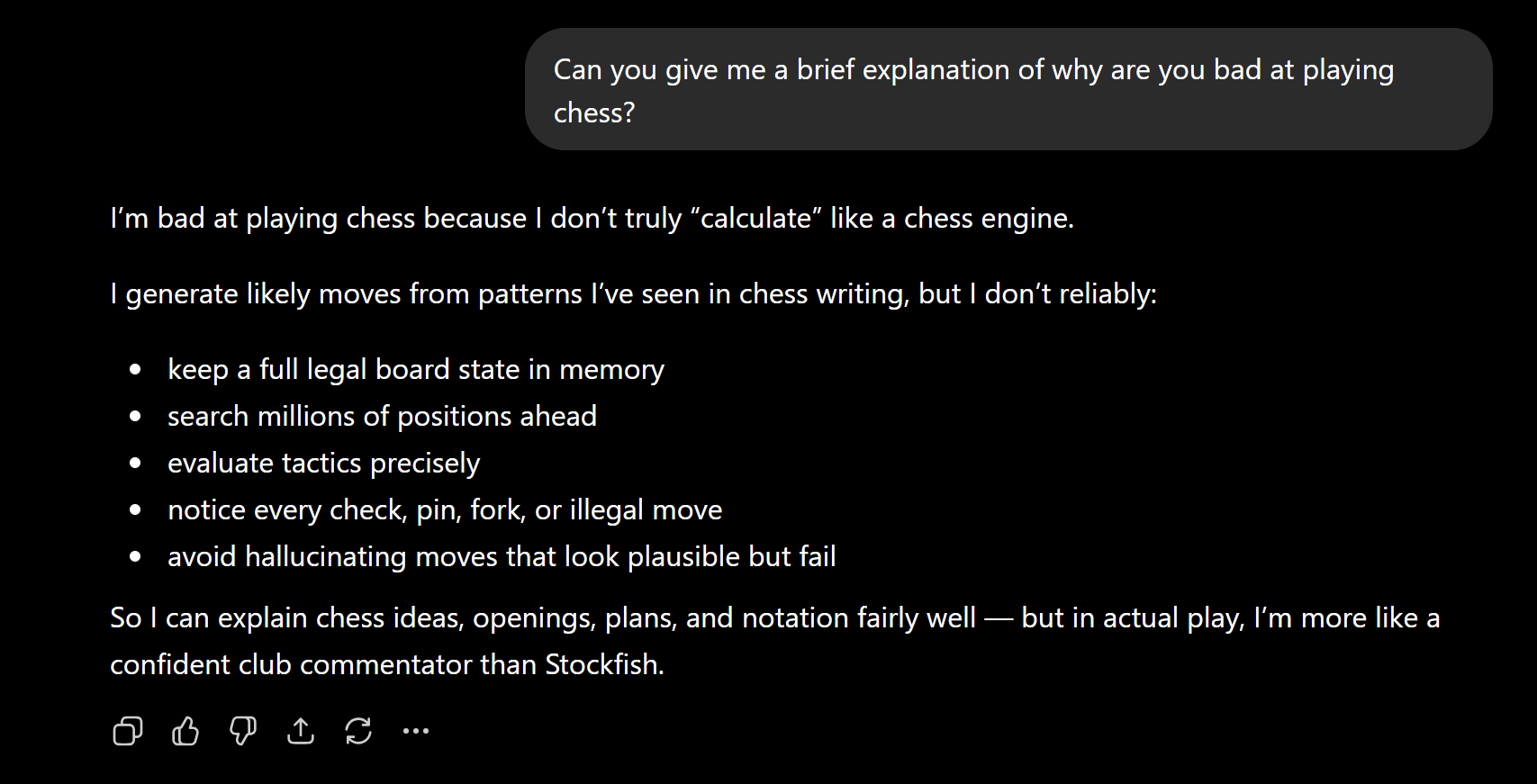
My brief conversation with ChatGPT :)
The Game Goes On
So is AI bad at chess? No. AlphaZero is arguably the greatest chess player that has ever existed - human or machine.
Is ChatGPT bad at chess? Yes - but that was never what it was built for.
They are two completely different things, and the headlines that confused them were missing the point entirely.
Humans are still playing. Still competing. Still trying to find out who is the best - even knowing we can never beat computers again.
But for us mere mortals, chess was never really about that. It's about sitting down across from your friend or family, forgetting about everything in the outside world, and losing yourself in chess world.
Having fun - that's something no engine has ever been able to replicate.
If this post has made you want to play - we'd love to help you find your perfect chess set :)
- The easiest way to start: Tournament Sets
- The classic beauty of: Wooden Sets
- The affordable luxury of: Marble Sets
The newest additions - nice wooden chess sets doesn't have to be big or expensive:
- The Toledo Studio Chess Set with wooden pieces
- The Granada Studio Chess Set with tournament pieces
Further Reading:
- Chess Grandmaster Magnus Carlsen Beats ChatGPT Without Losing a Single Piece
- The Machine That Made the World Believe in Artificial Intelligence
- Turochamp & First computers
- Deep Blue by IMB
- Stockfish
- AlphaZero: Shedding new light on chess, shogi, and Go
- Alpha Zero’s “Alien” Chess Shows the Power, and the Peculiarity, of AI
- Leela Chess Zero